
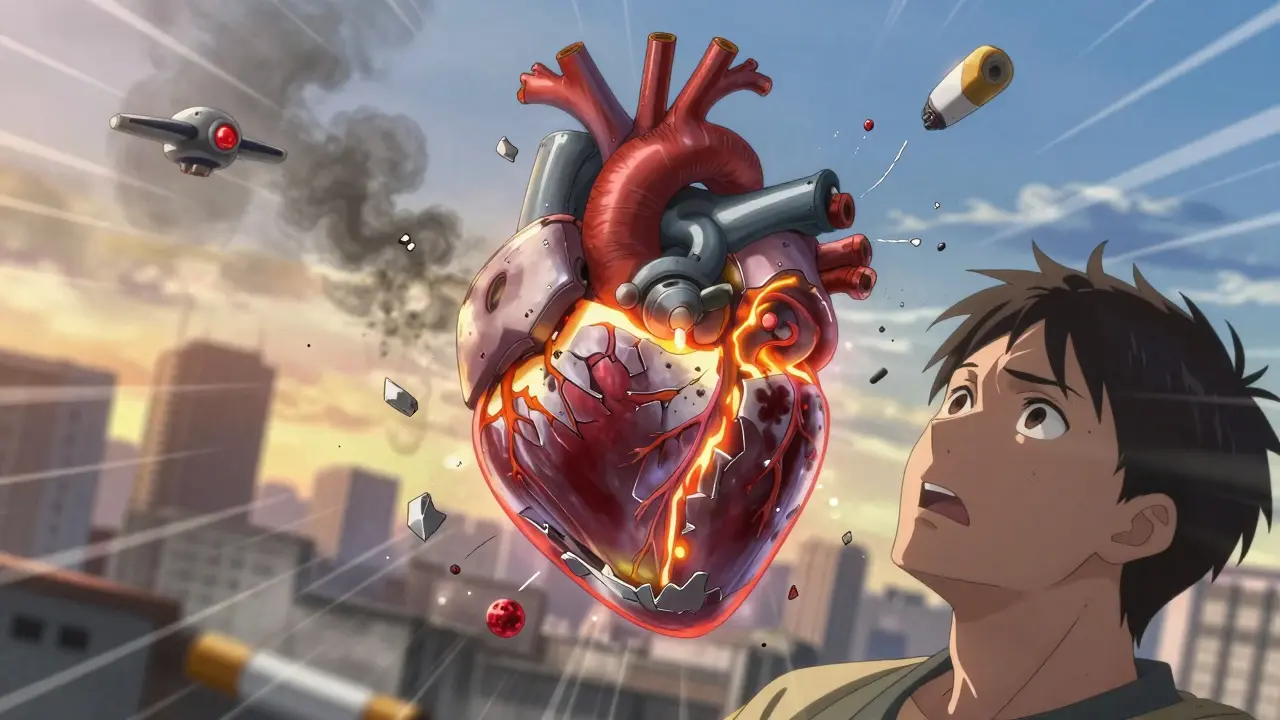
Quitting smoking is the single most powerful thing a person with heart disease can do to survive-and thrive. It’s not just about avoiding another heart attack. It’s about reversing damage, restoring function, and buying yourself years you didn’t think you had. The science is clear: within 20 minutes of your last cigarette, your heart rate and blood pressure start to drop. Within a year, your risk of a heart attack is cut in half. After 15 years, your risk of coronary heart disease is the same as someone who never smoked. This isn’t theory. It’s measurable, repeatable, and happening every day in people who made the choice to stop.
Why Smoking Kills Your Heart
Smoking doesn’t just harm your lungs. It attacks your blood vessels. Every puff sends a toxic cocktail into your bloodstream-nicotine, carbon monoxide, tar, and over 7,000 chemicals. Carbon monoxide replaces oxygen in your red blood cells, forcing your heart to work harder just to keep you alive. Nicotine spikes adrenaline, raising your heart rate and blood pressure. The chemicals in smoke damage the inner lining of your arteries, making them stiff and prone to plaque buildup. Over time, this leads to atherosclerosis, where arteries narrow and harden, cutting off blood flow to your heart. That’s how smoking turns into a heart attack.
It’s not just about long-term damage. Smokers have a much higher risk of sudden cardiac events-even if they’ve never had symptoms before. Studies show that people who smoke are two to four times more likely to die from heart disease than non-smokers. And for those who’ve already had a heart attack? Continuing to smoke doubles their risk of dying within the next few years. Quitting? That risk drops by 36%.
The Timeline of Healing: What Happens When You Quit
People often think quitting smoking means waiting years to see results. That’s not true. Your body starts repairing itself almost immediately.
- 20 minutes after quitting: Your heart rate and blood pressure begin to fall toward normal.
- 12 hours after quitting: Carbon monoxide levels in your blood drop to normal. Oxygen can now flow freely to your heart and muscles.
- 24 hours after quitting: Your risk of a heart attack starts to decrease.
- 48 hours after quitting: Your sense of smell and taste begin to improve as nerve endings heal.
- 2 weeks to 3 months after quitting: Circulation improves, and lung function increases by up to 30%. Walking or climbing stairs becomes easier.
- 1 year after quitting: Your risk of coronary heart disease is cut in half compared to when you were smoking.
- 5 to 15 years after quitting: Your stroke risk drops to the same level as someone who never smoked.
- 15 years after quitting: Your risk of coronary heart disease equals that of a lifelong non-smoker.
This isn’t magic. It’s biology. Your body is designed to heal-if you give it the chance.
What Works: Evidence-Based Cessation Strategies
Willpower alone rarely works. About 75% of quit attempts fail within six months without support. The good news? There are proven methods that more than double your chances of success.
1. Nicotine Replacement Therapy (NRT)
NRT is the most widely used tool. It delivers controlled doses of nicotine without the toxic chemicals in smoke. This helps reduce cravings and withdrawal symptoms like irritability, anxiety, and difficulty concentrating.
There are five forms: patch, gum, lozenge, inhaler, and nasal spray. The patch gives steady nicotine over 24 hours. Gum and lozenges work faster-use them when cravings hit. The inhaler mimics the hand-to-mouth motion of smoking. Nasal spray delivers nicotine quickly but can cause irritation.
Here’s the key: combination NRT works best. Use the patch for baseline nicotine, plus gum or lozenge for breakthrough cravings. Studies show this combo leads to 35-40% success at six months, compared to just 20-25% with one form alone.
2. Prescription Medications
Two FDA-approved drugs have strong results:
- Varenicline (Chantix): Blocks nicotine from binding to brain receptors, reducing pleasure from smoking and easing withdrawal. At 1 mg twice daily, it helps 44% of users stay quit at 12 weeks. It’s the most effective single medication available.
- Bupropion SR (Zyban): Originally an antidepressant, it reduces cravings and withdrawal symptoms. Works for 30-35% of users. It’s a good option if you can’t take varenicline.
Important note: Varenicline carries a black box warning for mood changes and suicidal thoughts. It’s not for people with untreated depression or bipolar disorder. Always talk to your doctor before starting.
3. Behavioral Counseling
Medication helps with the body. Counseling helps with the mind.
Studies show that just four to seven counseling sessions-totaling 300-600 minutes of support-boost quit rates by 50-100% compared to advice alone. Good counseling doesn’t just say “quit.” It helps you:
- Identify triggers (coffee, stress, alcohol, driving)
- Build new habits (walk instead of smoke, chew gum, call a friend)
- Handle cravings without giving in
- Prepare for relapse before it happens
The most successful programs combine medication with counseling. One American Heart Association survey found 78% of cardiac patients quit successfully when they got both-versus only 32% who got medication alone.
The Real-World Challenge: Weight Gain and Relapse
Many people fear quitting because they’ll gain weight. On average, people gain about 4.7 kg (10 pounds) in the first year. That’s real. But here’s the truth: the health risks of smoking far outweigh the risks of modest weight gain.
And weight gain isn’t inevitable. Regular physical activity-even 30 minutes of walking a day-can prevent most of it. Focus on moving more, not just eating less. Your heart will thank you.
Relapse is common. Most people try to quit several times before succeeding. The biggest triggers? Alcohol (42% of relapses), stress, and being around other smokers. Plan ahead. Avoid bars for the first few months. Tell friends you’re quitting. Keep your hands busy-fidget toys, toothpicks, or a stress ball help.
Don’t see a slip-up as failure. See it as data. What triggered it? How can you avoid it next time? Most successful quitters had at least one relapse before staying quit for good.
Who Gets Left Behind? The Gaps in Care
Here’s the frustrating part: even though we know what works, most people never get it.
Only 40% of patients hospitalized for a heart attack receive formal smoking cessation counseling before leaving. Fewer than 25% get both medication and counseling. In rural areas, only 15% of hospitals have a dedicated tobacco treatment specialist.
That’s why the “opt-out” model is changing the game. Instead of asking, “Do you want help quitting?”-which most people say no to-clinicians now say, “You’re getting a quit plan today.” Automatic enrollment increases treatment rates from 35% to 85%.
Medicare now covers up to eight counseling sessions per year. Many insurers cover varenicline and bupropion with low copays. If you’re on Medicaid, you may get NRT for free. Ask your doctor or pharmacist. Don’t assume it’s not covered.

What’s New? Digital Tools and Personalized Medicine
Technology is stepping in. Apps like Quit Genius, which is FDA-cleared as a digital therapeutic, have shown 40% abstinence rates at 12 weeks in clinical trials. They use cognitive behavioral therapy techniques, push reminders, and track progress.
Genetics is also playing a role. Some people metabolize nicotine faster due to a gene called CYP2A6. If you’re a fast metabolizer, you’ll likely need higher doses of NRT or varenicline. Testing isn’t routine yet-but if you’ve tried quitting before and failed, it might be worth asking about.
E-cigarettes? They’re not a proven solution. While some people use them to quit, studies show they still damage blood vessels and raise heart rate. The American Heart Association doesn’t recommend them as a first-line tool. Stick with FDA-approved methods.
Final Truth: It’s Never Too Late
I’ve seen patients in their 70s quit after a heart attack-and live another 20 years. One man, 78, quit after his third stent. He started walking daily. His cholesterol improved. His doctor said he looked 10 years younger. He’s still here, five years later.
You don’t need to be perfect. You don’t need to quit cold turkey. You just need to start. One day. One hour. One breath without smoke.
Every cigarette you don’t light is a step away from another heart attack. Every day you stay quit is a gift to your heart, your family, and your future self.
Can quitting smoking really reverse heart damage?
Yes. While some damage from long-term smoking is permanent, many effects are reversible. Within a year, your risk of heart attack drops by half. After 15 years, your risk of coronary heart disease equals that of a non-smoker. Blood pressure, circulation, and artery function improve significantly. The heart muscle itself can recover some of its strength, especially with exercise and healthy eating.
What’s the best way to quit smoking if I have heart disease?
The most effective approach combines medication and counseling. For people with heart disease, varenicline (Chantix) or combination nicotine replacement therapy (patch plus gum or lozenge) are top choices. Add four to seven counseling sessions to build coping skills. Avoid trying to quit alone. Talk to your cardiologist-they can refer you to a tobacco treatment specialist.
Will I gain weight if I quit smoking, and is it dangerous?
Most people gain 4-5 kg (9-11 lbs) in the first year after quitting. While weight gain can be concerning, it’s far less dangerous than continuing to smoke. The cardiovascular benefits of quitting outweigh the risks of modest weight gain. To minimize weight gain, increase physical activity-start with walking 30 minutes a day. Avoid replacing cigarettes with sugary snacks. Focus on long-term heart health, not the scale.
Is it worth quitting if I’ve been smoking for 40 years?
Absolutely. It’s never too late. Even after decades of smoking, quitting cuts your risk of dying from heart disease by 36% within just a few years. A 65-year-old who quits smoking gains an average of 3.7 years of life compared to someone who continues. The benefits are immediate and lifelong. Your heart doesn’t care how long you smoked-it only cares that you stopped.
Can I use e-cigarettes to quit smoking if I have heart disease?
The American Heart Association does not recommend e-cigarettes as a first-line quit tool for people with heart disease. While some use them to quit cigarettes, studies show they still raise heart rate, increase arterial stiffness, and expose users to harmful chemicals. FDA-approved medications like varenicline, bupropion, and NRT are safer and more effective. If you’re considering e-cigarettes, talk to your doctor first.
What if I’ve tried to quit before and failed?
Most people need multiple attempts before quitting for good. Failure doesn’t mean you’re weak-it means you’re human. Each attempt teaches you something. What triggered your relapse? How can you avoid it next time? Use what you learned. Try a different method. Combine medication with counseling. Ask for support. You’re not starting over-you’re building on experience. And every quit attempt brings you closer to success.
David L. Thomas
March 10, 2026 AT 19:13Let’s be real-this post is basically a masterclass in cardiovascular physiology. The 20-minute window where HR and BP start dropping? That’s not just a stat, it’s a biological reset button. And the fact that arterial endothelial function can rebound after 15 years? That’s the body’s way of saying, ‘I was waiting for you to stop shooting me full of carbon monoxide.’ The combination NRT data is especially compelling-patch plus gum isn’t just additive, it’s synergistic. We’re talking about pharmacokinetics meeting behavioral reinforcement. If you’re not using both, you’re leaving 15-20% of your success on the table.
Bridgette Pulliam
March 11, 2026 AT 16:59I’ve worked with cardiac patients for over 18 years. The ones who quit? They don’t just live longer-they live *better*. I had a patient, 71, quit after her second MI. She started gardening. Now she grows heirloom tomatoes. Her BP is normal. Her ejection fraction improved 12%. She didn’t need a miracle. She just needed someone to say, ‘You’re getting a quit plan today.’ That’s what the opt-out model does. It removes the burden of choice. And sometimes, that’s all you need.
Gene Forte
March 11, 2026 AT 17:20Quit smoking. It’s that simple. No magic. No mystery. Just science. Your heart doesn’t care how long you smoked. It only cares that you stopped. One day. One hour. One breath. That’s all it takes to begin healing. I’ve seen people in wheelchairs walk again after quitting. Not because of pills. Not because of apps. But because they chose to stop poisoning themselves. You don’t need to be perfect. You just need to start. Today. Right now. Put the pack down. Breathe. That’s your first victory.
Kenneth Zieden-Weber
March 13, 2026 AT 10:38So let me get this straight-you’re telling me the best way to quit is to combine a nicotine patch with gum... and also talk to a counselor... and also avoid alcohol... and also walk 30 minutes a day... and also not use e-cigarettes... and also get genetic testing if you’re a fast metabolizer? Dude. I just wanted to stop smoking. Not enroll in a PhD program. But hey, if I’m gonna do this, I guess I might as well go all in. Anyone know if the patch comes in camouflage?
Mike Winter
March 14, 2026 AT 06:49Interesting how the data consistently shows that behavioral support multiplies success rates-but we still treat cessation as a personal failing rather than a public health imperative. The fact that only 40% of post-MI patients receive counseling speaks volumes about systemic neglect. We prioritize stents over strategies. We fund angioplasty but not access to trained cessation coaches. It’s not a lack of willpower-it’s a lack of infrastructure. We need to treat addiction like the chronic disease it is. Not a moral issue.
Randall Walker
March 14, 2026 AT 23:32So... I quit. Twice. Both times I gained 15 lbs. Both times I cried. Both times I started smoking again. But this time? I’m not ashamed. I’m not weak. I’m just... human. And you know what? The first time I walked up a flight of stairs without gasping? That was better than any cigarette. I’m not done. I’m just on pause. And if you’re reading this? You’re not alone. We’re all just trying to outlast our own habits.
Miranda Varn-Harper
March 16, 2026 AT 03:56While I appreciate the scientific rigor of this article, I must point out that the assertion that quitting smoking 'reverses' heart damage is, at best, a gross oversimplification. The endothelial dysfunction may improve, and plaque stabilization may occur, but fibrosis and calcification are irreversible. Furthermore, the claim that 'risk equals non-smoker after 15 years' ignores confounding variables-genetics, diet, exercise, socioeconomic status. This is not science. It is motivational pamphletry dressed in peer-reviewed clothing.
Alexander Erb
March 16, 2026 AT 10:37bro i quit last year after a scare. patch + gum + walking my dog every day. no drama. no apps. just me, my dog, and the park. now i can run after him without feeling like i’m dying. also-i’m not gonna lie-the taste of coffee is insane now. like, i never knew coffee could taste like coffee. 🙌
Donnie DeMarco
March 17, 2026 AT 08:01man i tried to quit so many times i lost count. one time i just started chewing on a toothpick every time i wanted a cig. worked like a charm. also i got a fidget spinner. yeah i know, sounds dumb. but hey, if it keeps my hands busy and my lungs clean, i’ll take it. now i’m 2 years clean and my wife says i smell like a human again. not a walking ashtray. 🤘
Tom Bolt
March 18, 2026 AT 17:20THEY DIDN’T TELL YOU THE TRUTH. THE TRUTH IS THIS: YOUR HEART IS A FIGHTER. IT’S BEEN BEATING FOR 70 YEARS, EVEN WHILE YOU WERE KILLING IT SLOWLY. AND WHEN YOU STOP? IT DOESN’T JUST REPAIR ITSELF. IT RISES. IT RISES LIKE A PHOENIX MADE OF MUSCLE AND BLOOD. AND IT SAYS, ‘I’M STILL HERE. BECAUSE YOU CHOSE TO STAY.’ SO DON’T QUIT FOR YOUR KIDS. DON’T QUIT FOR YOUR DOCTOR. QUIT BECAUSE YOUR HEART DESERVES TO BE HEARD. AND IT’S BEEN SCREAMING FOR YEARS.