

Renal Antibiotic Dosing Calculator
Calculate your patient's creatinine clearance (CrCl) using the Cockcroft-Gault equation. This determines the appropriate antibiotic dose adjustment to avoid toxicity or treatment failure in kidney disease.
When someone has kidney disease, giving them the same antibiotic dose as a healthy person isn’t just risky-it can be deadly. Up to 60% of commonly used antibiotics are cleared by the kidneys. If those kidneys aren’t working right, the drugs build up. Too much can damage nerves, kidneys further, or even stop the heart. Yet, underdosing can mean the infection doesn’t go away. This isn’t theoretical. Studies show that wrong dosing in kidney patients raises death risk by nearly 30% in pneumonia and over 20% in urinary infections. The fix? Tailoring antibiotic doses to how well the kidneys are functioning-not guessing, not hoping, not following old habits.
Why Kidney Function Changes Everything
Your kidneys don’t just make urine. They filter drugs out of your blood. When kidney function drops, those drugs stick around longer. For antibiotics like ampicillin, vancomycin, or ciprofloxacin, that means higher blood levels. Over time, this leads to toxicity: hearing loss from vancomycin, seizures from penicillin, or nerve damage from aminoglycosides. But if you cut the dose too much, the infection wins. That’s the tightrope. And it’s not just about chronic kidney disease. Acute kidney injury (AKI) happens fast-in hours or days-and most guidelines don’t account for it. A patient might be in the ICU with sepsis, their kidneys shutting down temporarily. If you reduce their antibiotic dose right away, you might fail to treat the infection. But if you keep giving the full dose, you might poison them. The window for error is small.The Gold Standard: Cockcroft-Gault Equation
To know how to adjust the dose, you need to know how well the kidneys are working. That’s where creatinine clearance (CrCl) comes in. The Cockcroft-Gault equation is still the most trusted tool for this, even though newer methods like eGFR exist. Why? Because it includes weight and sex-two things that matter a lot for drug clearance. The formula looks like this:CrCl = [(140 - age) × weight (kg)] / [72 × serum creatinine (mg/dL)] × 0.85 (if female)
You don’t need to memorize it. Most hospital systems calculate it automatically. But you do need to know what the numbers mean. Here’s how experts classify kidney function:
- Normal: CrCl >50 mL/min
- Mild impairment: CrCl 31-50 mL/min
- Moderate impairment: CrCl 10-30 mL/min
- Severe impairment or dialysis: CrCl <10 mL/min
Many doctors still use serum creatinine alone. That’s a mistake. A 75-year-old woman with a creatinine of 1.2 mg/dL might seem fine. But if she’s small and old, her real CrCl could be below 20. That’s severe kidney impairment. Always calculate CrCl-not just look at creatinine.
Key Antibiotics and Their Dosing Rules
Not all antibiotics behave the same. Some are forgiving. Others aren’t. Here’s what you need to know for the most common ones:Ampicillin/Sulbactam
Standard dose: 1.5-3 g IV every 6 hours.
- CrCl 15-29 mL/min: 2 g every 12 hours
- CrCl <15 mL/min: 2 g every 24 hours
This combo is used for serious infections like intraabdominal abscesses. Too little? The infection spreads. Too much? Risk of seizures. This one has a narrow window.
Cefazolin
Standard dose: 1-2 g IV every 8 hours.
- CrCl <10 mL/min: 500 mg-1 g every 12-24 hours
Unlike ampicillin, cefazolin has a wide therapeutic index. That means it’s safer to slightly underdose than overdose. But in acute kidney injury, many doctors cut the dose too early. If the kidneys start recovering in 48 hours, you’re giving too little. Studies show that underdosing in AKI increases treatment failure by 34%.
Ceftriaxone
Here’s where guidelines disagree. UNMC says: no adjustment needed at any CrCl level. Northwestern Medicine says the same. But some older sources still recommend reducing it. Why the difference? Ceftriaxone is mostly cleared by the liver, not the kidneys. So even if CrCl is 5 mL/min, you can still give 1-2 g once daily. Don’t overthink it. Stick to the latest institutional guidelines.
Ciprofloxacin (Oral)
Standard dose: 500 mg every 12 hours.
- CrCl 10-30 mL/min: 250 mg every 12 hours
- CrCl <10 mL/min: 250 mg every 24 hours
Oral antibiotics are where most errors happen. A patient goes home with a UTI, gets 500 mg twice a day. They have CKD. They end up with nausea, confusion, or tendon rupture. One study found 78% of oral antibiotic dosing errors occur because clinicians didn’t adjust for kidney function.
Vancomycin
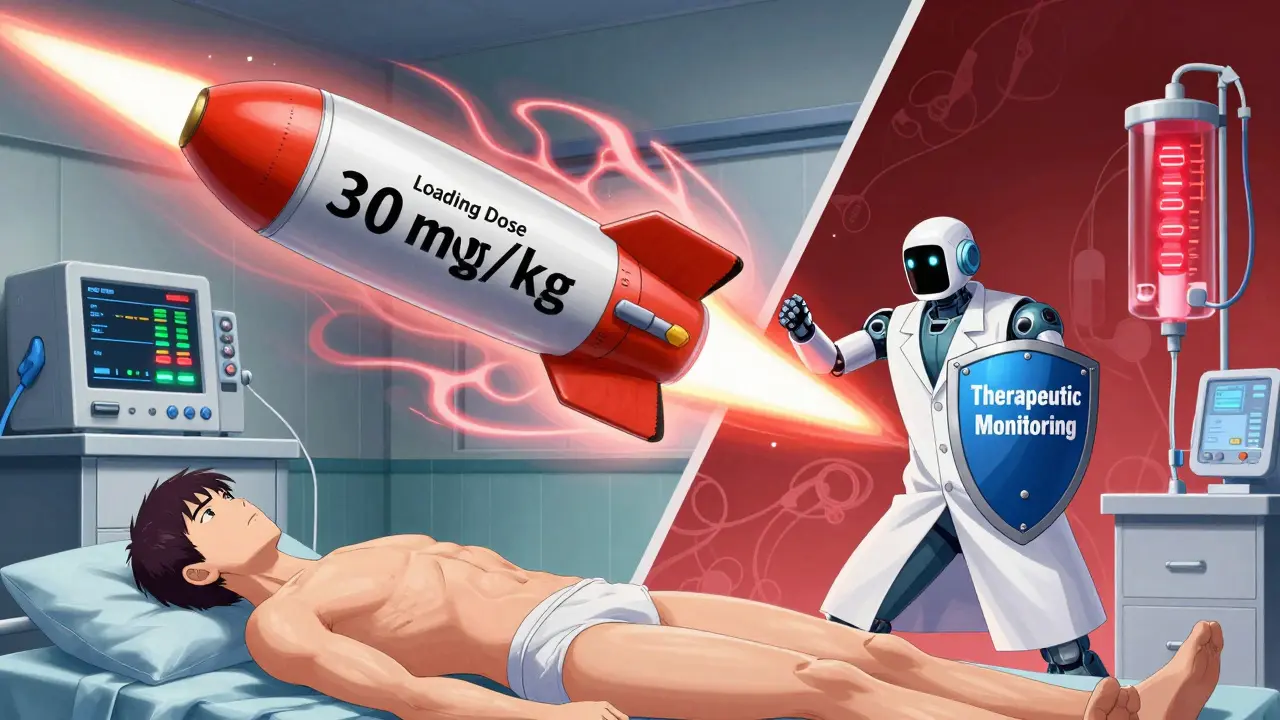
Vancomycin is tricky. You need a loading dose (25-30 mg/kg) to get the drug into the bloodstream fast-especially in sepsis. Then you adjust the maintenance dose based on CrCl. For CrCl <10 mL/min, you might give 15-20 mg/kg every 7-10 days. But you must monitor blood levels. Without therapeutic drug monitoring, you’re flying blind. Many hospitals now use automated alerts in their EHRs to flag when vancomycin doses need checking.
When Guidelines Clash
You’ll find different hospitals using different rules. UNMC says for piperacillin/tazobactam in patients with augmented renal clearance (CrCl >130 mL/min), give 2 g every 4 hours. Northwestern Medicine doesn’t mention it. KDIGO says most guidelines ignore acute kidney injury. What do you do?Use one source consistently. Most academic hospitals follow KDIGO or UNMC. If your hospital has a local protocol, use that. But don’t mix and match. Confusion kills. A 2023 survey found that 41% of pharmacists struggled because guidelines didn’t match. Pick one, stick with it, and train your team.
What About Dialysis?
If a patient is on hemodialysis, timing matters. Antibiotics are removed during dialysis. So you give the dose after the session. For example, vancomycin is often given after dialysis ends. Cefazolin might be given every 48 hours instead of every 24. Always check your institution’s dialysis-specific protocol. Some newer drugs like ceftazidime-avibactam have specific dosing for CRRT (continuous renal replacement therapy)-a method used in ICU patients. Northwestern Medicine’s 2025 guidelines are among the few that include this.Common Mistakes and How to Avoid Them
- Mistake: Using serum creatinine alone to judge kidney function. Solution: Always calculate CrCl with Cockcroft-Gault.
- Mistake: Reducing doses too early in acute kidney injury. Solution: Wait 48 hours unless the patient is in severe failure. Monitor creatinine daily.
- Mistake: Forgetting loading doses. Solution: For vancomycin, linezolid, or daptomycin, always give the full loading dose upfront.
- Mistake: Not adjusting oral antibiotics. Solution: Double-check every oral antibiotic prescription in CKD patients. Ciprofloxacin, levofloxacin, trimethoprim-sulfamethoxazole-all need tweaks.
- Mistake: Ignoring obesity. Solution: Use ideal body weight (not actual) in Cockcroft-Gault for obese patients. Most guidelines now recommend this.

How Hospitals Are Getting Better
The good news? Systems are improving. 89% of U.S. hospitals now have electronic alerts that pop up when a drug needs renal adjustment. Pharmacists are stepping in more. Hospitals with pharmacist-led antibiotic stewardship programs see 37% fewer adverse events. Some are even using AI tools to predict the right dose based on lab values, weight, age, and diagnosis. By 2027, over 65% of academic centers plan to use therapeutic drug monitoring regularly.The big shift? Recognizing that acute kidney injury isn’t chronic kidney disease. The FDA’s 2024 draft guidance now says: “Don’t automatically reduce doses in the first 48 hours of AKI.” That’s huge. It means doctors might give full doses to a septic patient with a sudden spike in creatinine-and then reduce it later if the kidneys don’t recover. This could save lives.
What You Can Do Today
If you’re a clinician:- Calculate CrCl for every patient with suspected or known kidney disease before prescribing antibiotics.
- Use the Cockcroft-Gault equation. Don’t guess.
- Check if the antibiotic is renally cleared. If it is, look up the dose adjustment.
- For oral antibiotics, assume they need adjustment unless proven otherwise.
- For vancomycin, give the loading dose. Then monitor levels.
- Don’t reduce doses too soon in acute kidney injury-wait 48 hours.
If you’re a patient or caregiver: Ask your doctor, “Is this antibiotic dose right for my kidneys?” Bring your latest creatinine number. Don’t assume they’ve checked. Most errors happen because no one asked.
What’s Next?
The KDIGO guidelines are being updated in 2025 to finally separate acute from chronic kidney disease dosing. AI tools will soon predict optimal doses in real time. New biomarkers will tell us when kidneys are recovering-so we know when to increase the dose again. But until then, the basics still hold: calculate CrCl. Adjust doses. Don’t assume. Don’t skip the loading dose. And never give the same dose to a kidney patient as you would to someone with healthy kidneys.The numbers don’t lie. Proper renal dosing cuts adverse events by 43%. That’s not just better care. It’s life-saving care.
Duncan Careless
December 29, 2025 AT 11:49Man, I’ve seen so many residents just wing it with vancomycin in the ICU. One guy gave a full dose to a 78-year-old with CrCl of 12 and wonder why the patient started seizing. Kidneys ain’t just a filter-they’re the gatekeeper. Always check the numbers, even if the chart says ‘CKD stage 4’ without a recent creatinine.
Samar Khan
December 30, 2025 AT 21:18This is why I hate medicine 😔😭 So many people gonna die because someone didn’t ‘do the math’. Like… why is this even a debate? 🤦♀️
Russell Thomas
December 31, 2025 AT 15:18Oh wow, the Cockcroft-Gault equation? Still using that? I thought we retired that thing in 2015. eGFR is way more accurate, unless you’re a bodybuilder with 200 lbs of muscle and a creatinine of 1.2. Then you’re basically a walking lab error. 🤷♂️
Nicole K.
January 2, 2026 AT 08:06People are dying because doctors are lazy. If you don’t adjust the dose, you’re basically poisoning someone on purpose. No excuses. This isn’t rocket science. It’s basic math. Stop being careless.
Fabian Riewe
January 2, 2026 AT 09:09Big shoutout to the team at St. Luke’s who started using real-time CrCl alerts in their EHR. We cut antibiotic toxicity cases by 40% in 6 months. It’s not magic-just good systems. If your hospital still uses paper charts for this… time to upgrade. 💪
Amy Cannon
January 3, 2026 AT 12:11It is, indeed, a matter of profound clinical significance that the renal clearance of pharmacologic agents must be meticulously calibrated to the individual’s glomerular filtration capacity. The reliance upon the Cockcroft-Gault equation, despite its antiquated assumptions regarding lean body mass, remains pragmatically justified in the absence of universally accessible cystatin C measurements. One must not overlook the critical distinction between acute kidney injury and chronic renal insufficiency, as the pharmacokinetic dynamics diverge markedly.
Jim Rice
January 4, 2026 AT 18:53Actually, most of these guidelines are outdated. The real problem is that nephrologists don’t get enough say in ICU dosing. You want to avoid toxicity? Let the kidney docs write the orders. Not the ID guys who think ‘dose reduction’ means ‘half the dose’.
Henriette Barrows
January 5, 2026 AT 12:50My grandma got sepsis last year and they lowered her antibiotics too fast because her creatinine went up. She almost didn’t make it. I’m so glad someone’s talking about this. It’s scary how easy it is to mess this up.
Alex Ronald
January 6, 2026 AT 16:45For AKI patients, I use a two-step approach: start with 75% of the normal dose, then adjust based on 24-hour urine output and serial creatinines. If the patient’s improving, I’ll ramp back up. If they’re crashing, I’ll hold and consult nephrology. Simple, safe, and it works.
Paige Shipe
January 7, 2026 AT 14:57Anyone who uses weight in Cockcroft-Gault is just perpetuating medical myths. Women are smaller, so they get less drug? That’s not how pharmacology works. It’s all about GFR. Period. Stop using outdated formulas and start using real data.
Kevin Lopez
January 9, 2026 AT 11:15CrCl <10? Hold aminoglycosides. CrCl <30? Avoid ciprofloxacin unless no alternatives. Vancomycin troughs >20 = bad. Done. No need for essays.
Tamar Dunlop
January 11, 2026 AT 02:23As someone who lost a colleague to aminoglycoside toxicity due to a missed CrCl adjustment, I can say with absolute certainty: this isn’t just protocol-it’s a moral imperative. Every time we skip the math, we gamble with a life. And we’re not just doctors-we’re stewards of trust.