

When a new drug hits the market, most people assume it’s protected by a patent-and that patent runs out after 20 years. But in reality, many brand-name drugs stay off-limits to generics for two decades or more, even after their core patent expires. That’s not magic. It’s not luck. It’s a carefully engineered system of market exclusivity extensions-regulatory tools designed to delay generic competition, often long after the original patent has expired.
Why Patents Aren’t Enough
A standard patent lasts 20 years from the date it’s filed. But for pharmaceutical companies, that clock starts ticking long before the drug even reaches patients. Clinical trials take 7-10 years. The FDA review process adds another 2-5 years. By the time a drug is approved, the patent may have only 5-8 years of life left. That’s not enough time to recoup the average $2.3 billion it costs to bring a new drug to market. That’s where the Hatch-Waxman Act of 1984 came in. It was meant to strike a balance: reward innovation while ensuring generics could enter the market eventually. The law created two main tools: patent term extension and regulatory exclusivity. But over time, these tools have become less about fairness and more about strategy.Patent Term Extension: The Legal Clock-Stopper
In the U.S., the FDA can grant a Patent Term Extension (PTE) to make up for time lost during regulatory review. The law caps this at five years, and the total market exclusivity after approval can’t exceed 14 years. So if a drug gets approved in year 12 of its patent life, it can get up to 2 more years added. But here’s the catch: only one patent per drug qualifies for extension, and only for the first approval of a new active ingredient. That means if a company files multiple patents covering different uses or formulations, only one can get the extension. So they don’t just file one patent-they file dozens. Take tazarotene, a skin treatment. Beyond its core patent, the manufacturer filed 48 additional patents covering things like packaging, dosing schedules, and combination therapies. Each one of these patents adds a layer of protection. Even if the original patent expires, a generic maker can’t launch without risking a lawsuit over one of these secondary patents.Regulatory Exclusivity: The Secret Weapon
Unlike patents, regulatory exclusivity doesn’t depend on filing paperwork with the USPTO. It’s granted automatically by the FDA-and it’s often stronger than patent protection because it can’t be challenged in court. There are five main types in the U.S.:- New Chemical Entity (NCE) exclusivity: 5 years of market protection for a drug with no previously approved active ingredient. During this time, the FDA can’t even accept a generic application.
- New Clinical Investigation exclusivity: 3 years for a new use, new dosage, or new delivery method-even if the active ingredient isn’t new. This is how drugs like Adderall extended their monopoly by adding an extended-release version.
- Orphan Drug exclusivity: 7 years for drugs treating rare diseases affecting fewer than 200,000 Americans. This one’s a big deal: 38% of all new drug approvals in 2022 were orphan drugs.
- Pediatric exclusivity: A 6-month bonus added to any existing exclusivity period. To get it, companies must complete FDA-requested pediatric studies. For blockbuster drugs, that’s often billions in extra revenue.
- 180-day generic exclusivity: The first generic company to challenge a patent gets a 6-month head start on other generics. It’s a carrot to encourage challenges-but sometimes, the brand-name company pays the generic maker to delay entry.
How Europe Does It Differently
The EU doesn’t use patent term extensions the same way. Instead, they rely on Supplemental Protection Certificates (SPCs). These can extend protection up to 15 years after market approval-slightly longer than the U.S. cap. The EU also gives 10 years of data exclusivity for new drugs, and 12 years if pediatric studies are completed. But here’s where the U.S. has an edge: stacking. The EU doesn’t allow multiple exclusivities to pile on the same drug the way the U.S. does. In Europe, orphan drug exclusivity runs alongside the SPC, but it doesn’t add extra time to it. In the U.S., you can have orphan exclusivity, pediatric extension, and NCE exclusivity all active at the same time. That’s why U.S. drugs often enjoy longer monopolies.The Real Game: Stacking and Product Hopping
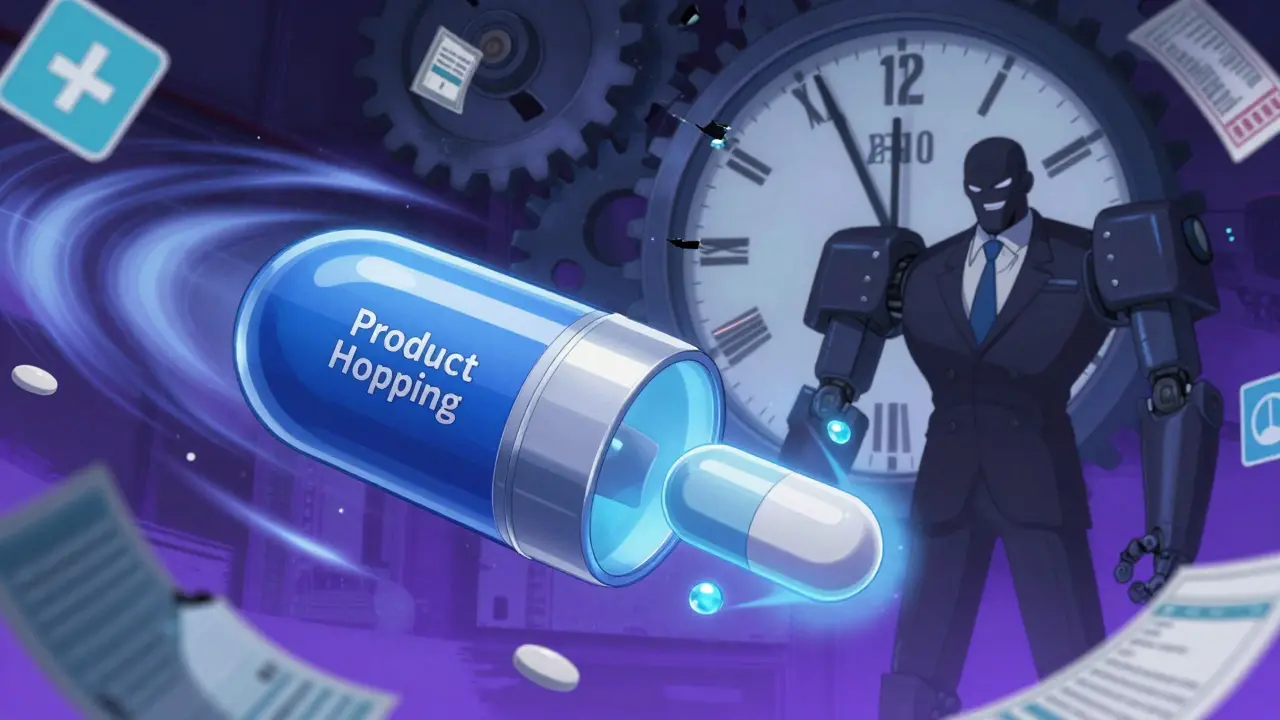
The most sophisticated players don’t wait for patents to expire. They plan years ahead. Companies like Bristol Myers Squibb and Novartis delay filing key patents until after Phase II trials. That way, the 20-year clock starts later, preserving more of the patent life for when the drug actually hits shelves. Then there’s product hopping. Just before a patent expires, a company launches a slightly altered version-say, a pill that dissolves in the mouth instead of being swallowed. It’s not a better drug. It’s not safer. But it’s different enough to trigger new exclusivity and scare off generics. Patients are switched to the new version, and insurers stop covering the old one. By the time generics are approved, the original drug is already off the market. Teva Pharmaceuticals reported in 2022 that this tactic delayed generic entry for 17% of their target drugs. The Federal Trade Commission has called it an antitrust violation-but enforcement is slow.
Who Benefits? Who Pays?
The system works brilliantly for pharmaceutical companies. A 2023 JAMA Health Forum study found that just four drugs-bimatoprost, celecoxib, glatiramer, and imatinib-cost the U.S. healthcare system an extra $3.5 billion over two years because generics couldn’t enter the market. That’s money that went straight into corporate profits. For patients, it means higher prices. For insurers, it means higher premiums. For taxpayers, it means higher Medicare and Medicaid spending. But it’s not all bad. Without these protections, many rare disease treatments wouldn’t exist. Orphan drug exclusivity has led to treatments for conditions like spinal muscular atrophy and Duchenne muscular dystrophy. Biotech startups say 68% of venture funding depends on the promise of exclusivity. The problem isn’t the existence of exclusivity-it’s how it’s being abused. When a drug gets 20+ years of protection not because it’s revolutionary, but because it’s been tweaked 48 times, that’s not innovation. That’s exploitation.What’s Changing?
Regulators are starting to push back. In 2023, the FDA tightened rules for 3-year exclusivity for new indications. Now, companies must prove real clinical benefit-not just a different formulation. The European Commission proposed reforms to SPCs to stop minor modifications from qualifying for extensions. The FTC is taking aim at product hopping. But the industry is fighting back. The Pharmaceutical Research and Manufacturers of America (PhRMA) argues that without these protections, drug development would collapse. They point to the $2.3 billion average cost of bringing a drug to market. Yet data shows that 91% of drugs with patent extensions still enjoy monopolies well beyond their expiration. The average extension period has grown from 3.1 years in 2000 to 9.2 years today. That’s not innovation-it’s inflation.What This Means for You
If you’re a patient, your prescription may cost more than it should. If you’re a policymaker, you’re seeing healthcare spending spiral. If you’re a generic manufacturer, you’re stuck waiting for legal loopholes to close. The truth is, market exclusivity extensions aren’t a flaw in the system. They’re the system. And until we redefine what counts as “innovation,” the only winners will be the companies that know how to game it.For now, the best advice for patients and payers? Watch the expiration dates-not just of patents, but of exclusivity periods. And ask: Is this drug truly new-or just a cleverly repackaged old one?
Can a drug have market exclusivity without a patent?
Yes. Regulatory exclusivity, like orphan drug or pediatric exclusivity, is granted by the FDA and doesn’t require a patent. A drug can be protected for 7 or 12 years based solely on its designation as a treatment for a rare disease or completion of pediatric studies-even if no patent exists.
How long can a drug stay protected after FDA approval?
In the U.S., the maximum is typically 14 years from approval for patent term extensions, but with stacking-NCE exclusivity (5 years), pediatric extension (+6 months), orphan exclusivity (7 years)-some drugs enjoy over 20 years of protection. In Europe, SPCs can extend protection up to 15 years after approval, plus data exclusivity.
What’s the difference between a patent and regulatory exclusivity?
A patent is a legal right granted by the USPTO that prevents others from making, using, or selling the invention. Regulatory exclusivity is an administrative protection granted by the FDA that blocks generics from even applying for approval for a set period. Patents can be challenged in court; exclusivity cannot.
Why do companies file so many secondary patents?
To create a “patent thicket.” Even if the core patent expires, generics can’t launch without infringing on one of the dozens of secondary patents covering packaging, dosing, or formulations. This delays generic entry through litigation risk, not technical barriers.
Does pediatric exclusivity really make drugs safer for kids?
Partly. The requirement to test drugs in children has led to better dosing guidelines and reduced off-label use. But the 6-month extension is often used strategically to delay generics, not improve pediatric care. Many studies show the clinical benefit for children is minimal in some cases, while the financial gain for companies is massive.
Jonny Moran
December 16, 2025 AT 08:17Man, I had no idea drugs could get protected for over 20 years just by changing the packaging. I thought patents were the only thing holding back generics. This is wild. My insulin costs $300 a month because they keep tweaking the formula. It’s not innovation-it’s greed.
And don’t get me started on how they switch patients over to the new version so insurers won’t cover the old one. That’s not healthcare-that’s corporate theater.
Sinéad Griffin
December 16, 2025 AT 12:09USA FOR LIFE 🇺🇸🔥 The system works because we fund the R&D. If you want cheap drugs, move to Canada and stop complaining. Pharma doesn’t make billions because they’re evil-they make it because they’re SMART. You want generics? Build your own lab. 🤷♀️💸
Rulich Pretorius
December 17, 2025 AT 10:05This is a classic case of institutional capture. The Hatch-Waxman Act was meant to be a compromise, but over time, the balance tipped entirely toward corporate interests. Regulatory exclusivity was never designed to be stacked like Lego bricks. When you combine orphan, pediatric, and NCE exclusivity, you're not incentivizing innovation-you're incentivizing legal engineering.
The real tragedy? The patients who need these drugs the most-those with rare diseases-are the ones who end up paying the highest prices because the system rewards obscurity over accessibility.
Thomas Anderson
December 18, 2025 AT 07:02So basically, companies file like 50 patents just to scare off generics? That’s not protecting innovation-that’s just bullying. I get they spent billions, but if the original patent’s expired, why can’t someone make the same pill for $5? It’s not rocket science.
My uncle takes glatiramer. Pays $1,200 a month. Generic should be $40. This is messed up.
Dwayne hiers
December 19, 2025 AT 22:47Let’s clarify the regulatory architecture: Patent Term Extension (PTE) under 35 U.S.C. §156 is statutorily capped at five years and cannot extend total exclusivity beyond 14 years post-approval. However, regulatory exclusivities-NCE (5 yrs), pediatric (6 mos), orphan (7 yrs)-are non-patent, non-challengeable administrative barriers enforced by the FDA under 21 U.S.C. §355. These are cumulative, non-overlapping, and operate independently of patent status.
Product hopping, while ethically dubious, is legally defensible under current antitrust jurisprudence unless there’s proof of sham litigation or reverse payment settlements. The FTC’s enforcement lag is structural, not incidental.
jeremy carroll
December 20, 2025 AT 03:53frankly i think we need to just let generics in sooner. like, if the drug works, why make people wait 20 years? companies get rich, we get broke. its not that hard. 🤷♂️
also why do we even have pediatric exclusivity? if it helps kids, cool. but if its just to delay generics, then nah. we can do better.
Alexis Wright
December 20, 2025 AT 13:38Oh, so now we’re pretending this is about ‘innovation’? Please. This isn’t capitalism-it’s feudalism with a FDA stamp. The same 10 corporations own the entire pipeline. They don’t cure diseases-they own the patents on the *idea* of curing them.
And don’t tell me about ‘$2.3 billion R&D costs.’ That’s a made-up number cooked up by PR firms. 80% of the foundational research was funded by taxpayers through NIH. They’re just the middlemen who slap on a $10,000 price tag and call it ‘value creation.’
Meanwhile, people are rationing insulin. We’re not just broken-we’re morally bankrupt.
Natalie Koeber
December 21, 2025 AT 07:15Did you know the FDA is secretly owned by Big Pharma? They’ve been inserting lobbyists into every review panel since the 90s. That’s why they keep approving these ‘new’ versions of old drugs-because they’re paid to. The whole system is a scam. Even the ‘orphan drug’ label? They’re gaming it. They classify common conditions as ‘rare’ just to get 7 extra years.
They’re not saving lives. They’re saving profits. And they’re doing it with our tax dollars.
Wake up. This is a controlled experiment in corporate dominance.
Wade Mercer
December 22, 2025 AT 06:04I don’t care how much money they spend. If a drug is lifesaving, it should be affordable. Charging $10,000 for a pill that costs $2 to make isn’t business-it’s theft. And the fact that we let this continue? That’s the real crime.
I’m not against innovation. I’m against profiteering off suffering.
Sarthak Jain
December 22, 2025 AT 12:46bro this is wild. in india we have generics for almost everything. like imatinib? 10 bucks a month. but here in us? 10k? how? 🤔
also the pediatric thing? i get the science, but the 6-month extension? that's just a delay tactic. companies are using kids' health as a business tool. not cool.
we need transparency. like, publish the real R&D costs. not the PR version.