
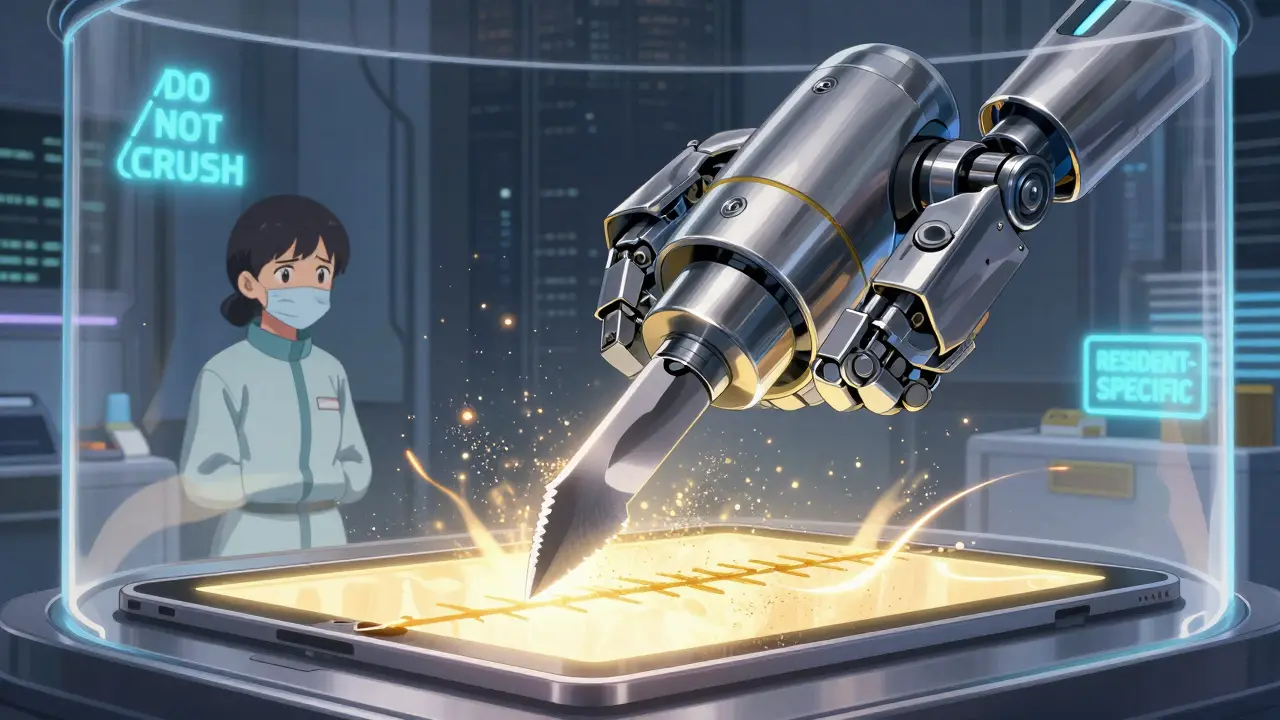
Splitting or crushing pills might seem like a simple fix-maybe you’re trying to save money, make it easier to swallow, or adjust a dose. But if you don’t do it right, you could be exposing yourself or someone you care for to serious risks: uneven doses, toxic dust, or even life-threatening contamination. This isn’t just about being careful-it’s about following science-backed steps that keep medication working the way it’s meant to.
Why Contamination Happens (And Why It’s Dangerous)
When you crush or split a pill, you’re breaking open its protective shell. Many pills are designed with special coatings to control how and where the drug is released in your body. Enteric-coated pills, for example, are made to dissolve in the intestines, not the stomach. Crush those, and you risk stomach irritation or reduced effectiveness. Sustained-release tablets are engineered to release medicine slowly over hours. Split them, and you could get a dangerous rush of medication all at once. But the bigger danger? Cross-contamination. If you use the same pill splitter or crusher for different medications-say, warfarin one day and levothyroxine the next-you’re transferring tiny particles from one drug to another. Even a few nanograms of a cancer drug like cyclophosphamide on a blade can be harmful. Healthcare workers have tested positive for exposure from shared equipment. For someone on blood thinners, a tiny bit of another drug can throw off their entire treatment. The FDA and ISMP warn that improper splitting contributes to over 8% of medication errors in long-term care. And it’s not just facilities-home caregivers often use kitchen scissors or a knife because they don’t have the right tools. That’s not safe.What Pills Should Never Be Split or Crushed
Not all pills can be split or crushed-and most people don’t know the difference. Here’s the hard rule: if it’s not scored, don’t split it. If it’s coated, delayed-release, or labeled "do not crush," don’t crush it. These types of pills are almost always unsafe to alter:- Extended-release (XR, ER, SR) tablets
- Enteric-coated tablets (often have "EC" on them)
- Capsules with pellets inside
- Hazardous drugs (chemotherapy, hormone therapies, antivirals)
- Sublingual or buccal tablets (meant to dissolve under the tongue)
The Right Tools for the Job
A pill splitter isn’t just a plastic gadget with a blade. The right one has a v-shaped holder that holds the pill steady, a retractable stainless steel blade with a 0.05mm tolerance, and a cover to catch fragments. Models like the Silent Knight or Med-Plus Pro are designed to minimize dust and ensure even splits. For crushing, use a closed-system crusher. Open crushing-like using a mortar and pestle or a pill crusher with an open top-releases airborne particles. Hazardous drugs like cyclophosphamide can become aerosolized and stick to skin, clothes, or surfaces. The Silent Knight system contains 99.8% of particles. Standard open crushers? Only 72%. That’s a massive difference. Don’t use scissors, knives, or your fingers. They’re inaccurate and unhygienic. A 2021 University of Jordan study showed that using a proper splitter gave 92.4% dose accuracy. Manual breaking? Only 63.7%.
Step-by-Step: How to Split or Crush Safely
Follow these steps every single time. No shortcuts.- Wash your hands. Use soap and water for at least 20 seconds. Dry with a clean towel.
- Wear gloves. Nitrile or latex-free gloves prevent skin contact with drug residue. Change them after each pill.
- Use a clean, dedicated tool. Never use the same splitter or crusher for different medications without cleaning it first.
- Disinfect the tool. Wipe the blade and container with a 70% isopropyl alcohol wipe. Let it air dry.
- Place the pill correctly. Align the scored line with the blade. Use a splitter with a visual guide if available.
- Split or crush in one motion. Don’t press multiple times. That creates more dust and uneven pieces.
- Use the dose immediately. Don’t store split or crushed pills. They degrade faster and can absorb moisture or contaminants.
- Dispose of waste properly. Place used gloves, wipes, and pill fragments in a sealed bag. Don’t toss them in the regular trash if it’s a hazardous drug. Ask your pharmacy about take-back programs.
One-Time Splitting? No. Always Split as Needed.
Some people split a whole month’s supply at once and store the halves. That’s a bad idea. The FDA explicitly says: "Do not split the entire supply at one time and then store them." Once a pill is split, the exposed surface starts to break down. Moisture, light, and air can change how the drug works. A 2023 study found that split tablets lost up to 15% of their potency after just 7 days when stored at room temperature. That’s not a small loss-it’s enough to make a blood pressure or seizure medication ineffective. Always split one pill at a time, right before taking it.What About Shared Equipment in Care Homes?
In nursing homes or assisted living, shared pill splitters are common. But they’re also a major source of contamination. A 2023 survey found that only 34.6% of staff cleaned splitters between different medications-even though guidelines say they must. The fix? Assign a dedicated splitter to each resident. Label it with their name. Use color-coded tools for different drug classes. If that’s not possible, clean thoroughly with alcohol wipes after every single use. Document it. If you’re a caregiver or family member, ask the facility: "Do you use resident-specific splitters? How often are they cleaned?" A 2024 case study at Sunrise Senior Living showed that switching to resident-specific splitters cut medication errors by 32.5% in just six months.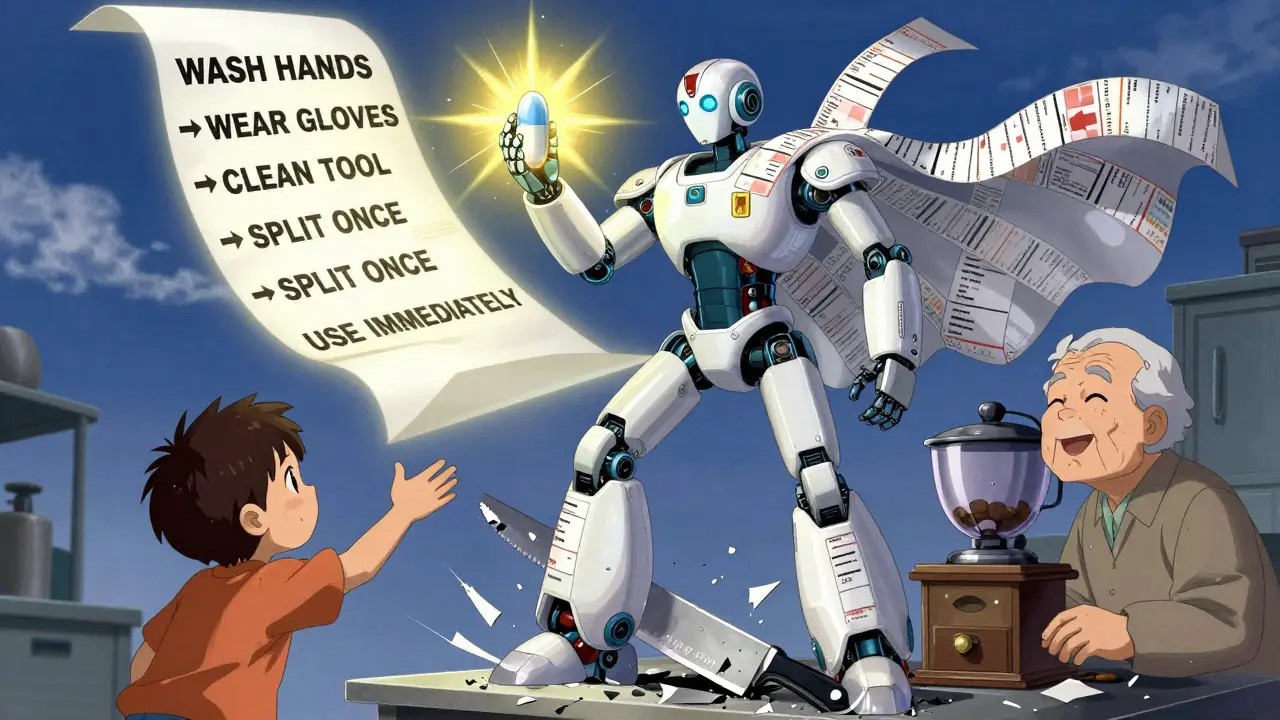
What to Do If You’ve Been Splitting Pills Wrong
If you’ve been using scissors, crushing pills in a coffee grinder, or reusing a splitter without cleaning it-don’t panic. But do act. First, stop. Immediately. Don’t take any more split or crushed pills until you’ve reviewed your method. Second, talk to your pharmacist. Bring the pills you’ve been altering. Ask:- "Is this safe to split or crush?"
- "What’s the right tool to use?"
- "Can you give me a pre-split dose instead?"
When to Ask for Help
You shouldn’t have to guess. If you’re unsure whether a pill can be split, or if you’re caring for someone with multiple medications, ask for help. - Talk to your pharmacist before splitting anything. They have access to databases that tell them exactly which drugs are safe to alter. - Ask your doctor if a liquid version or a different tablet strength is available. Often, it’s easier and safer than splitting. - If you’re a caregiver, request training. Many hospitals and pharmacies offer free medication safety workshops. - Use the ISMP’s free pill splitter checklist. It’s available online and helps you verify your technique.The Bigger Picture: Why This Matters
Pill splitting saves money-about $1.2 billion a year in the U.S. when done right. But when done wrong, it costs lives. A 2022 study found that proper technique reduced medication errors by 67%. That’s not just a number. It’s someone avoiding a stroke, a fall, or a hospital stay. New tech is helping. Smart splitters like Med-Engage’s 2024 FDA-cleared device can verify the dose before it’s taken. But until those are everywhere, the safest tool is still knowledge-and discipline. Don’t treat pill splitting like a kitchen hack. Treat it like a medical procedure. Because it is.Can I crush my pills to make them easier to swallow?
Only if your pharmacist or doctor says it’s safe. Many pills-especially extended-release, enteric-coated, or hazardous drugs-must never be crushed. Crushing them can cause dangerous side effects or make the medicine useless. Always check with your pharmacist first.
Is it okay to use scissors to split pills?
No. Scissors are inaccurate and unhygienic. They don’t split pills evenly, and they can leave behind drug residue that contaminates future doses. Use a dedicated pill splitter with a stainless steel blade instead. It’s safer, more precise, and designed for this purpose.
How often should I clean my pill splitter?
Clean it with a 70% isopropyl alcohol wipe after every single use-especially if you’re splitting different medications. Even if it looks clean, microscopic particles can remain. Let it air dry before using it again. Never share a splitter between people without thorough cleaning.
Can I store split pills for later use?
No. The FDA advises against splitting your entire supply at once. Once a pill is split, the exposed surface can degrade from moisture, light, and air. Potency can drop by up to 15% in just a week. Always split one pill right before taking it.
What should I do if I accidentally crush a pill that shouldn’t be crushed?
Stop taking it. Contact your pharmacist or doctor immediately. Do not take the crushed dose unless instructed to do so. They can advise whether it’s safe to proceed or if you need a replacement. If it was a hazardous drug, wash your hands and any surfaces that came into contact with the powder.
Are there alternatives to splitting pills?
Yes. Many medications come in different strengths, so you may not need to split at all. Liquid forms, patches, or dissolvable tablets are often safer alternatives. Ask your pharmacist if a different formulation is available for your prescription.
Janette Martens
December 28, 2025 AT 23:11why the hell are we even talking about this like it’s rocket science? i’ve been splitting my blood pressure pills with a knife since 2018 and i’m still standing. if your pharmacist is scared of a little dust, maybe they need a new job. #canadacan
Marie-Pierre Gonzalez
December 30, 2025 AT 10:01Thank you for this incredibly thorough and vital guide. 🙏 I’ve been a caregiver for my mother with Parkinson’s, and I had no idea how dangerous improper pill splitting could be. I’ve ordered a Silent Knight splitter today and will be using gloves from now on. Your clarity has given me peace of mind. 💙
Louis Paré
December 30, 2025 AT 10:29Let’s be real-this whole post reads like a pharmaceutical ad disguised as public service. Who the hell is paying you to scare people into buying $80 pill splitters? The FDA doesn’t own your soul. If I can crush my gabapentin with a spoon and not die, why are we turning a simple act into a biohazard drill? This is fearmongering dressed in lab coats.
Julius Hader
January 1, 2026 AT 02:48I really appreciate how detailed this is. Honestly, I used to crush my meds with a spoon because I thought it was fine. After reading this, I felt kinda guilty-and then I called my pharmacist. They gave me a pre-split version for free. Seriously, talk to your pharmacist. They’re not just there to hand out pills. 🙌
Vu L
January 2, 2026 AT 08:56lol at the 97.8% stat. so you're telling me i can't crush my vitamin d? what about my generic ibuprofen? i’ve been doing this since college. you're telling me my headache is now a biohazard?
Mimi Bos
January 2, 2026 AT 16:41i just split my amlodipine with a knife and i'm from texas so i don't care what the fda says. but also like... why is everyone so serious? it's a pill, not a bomb. 🤷♀️
Sydney Lee
January 3, 2026 AT 20:07It’s fascinating how society has normalized the casual mutilation of pharmaceuticals while simultaneously fetishizing precision in every other domain of health. We will spend $300 on a Fitbit that tracks our REM cycles, yet we’ll use a butter knife to fracture a time-release capsule like it’s a Sunday pancake. This isn’t negligence-it’s epistemological decay. The pill splitter is not a tool; it is a sacrament of medical integrity.
oluwarotimi w alaka
January 4, 2026 AT 21:23you think this is about safety? nah. this is big pharma’s way to sell more gadgets. they want you to buy splitters, gloves, alcohol wipes. meanwhile, they charge $500 for a pill that should cost $2. they don’t care if you live or die-they care about your credit card. i’ve seen it happen in my village back home. they don’t have splitters. they don’t die. they just get better.
Debra Cagwin
January 5, 2026 AT 07:52This is such an important topic-and thank you for writing it with such care. If you’re reading this and you’ve been splitting pills without knowing the risks, please don’t beat yourself up. You’re not alone. The real win is that you’re here, learning. Reach out to your pharmacist today. They’re trained to help, and they won’t judge you. You deserve to take your meds safely. 💪❤️