

Hospitals don’t just stock any drug that’s available. They don’t pick the cheapest option on a whim. And they don’t let doctors order whatever they want without oversight. Instead, every medication used in a hospital - especially generic drugs - goes through a strict, evidence-based system called a formulary. This isn’t just a list. It’s a living, breathing decision-making engine that balances clinical outcomes, safety, and cost. Understanding how it works reveals why some generics are available while others aren’t, and why patients sometimes get surprised by a different pill than they expected.
What Exactly Is a Hospital Formulary?
A hospital formulary is a curated list of approved medications. It’s not static. It’s updated regularly - often quarterly - based on new data, supply issues, and clinical feedback. The goal? To make sure patients get the safest, most effective drugs at the lowest possible cost to the system. This system started gaining structure in the 1970s in the U.S., when hospitals realized they needed a formal way to manage growing drug inventories and rising costs. Today, most U.S. hospitals with 100+ beds have a formal formulary, and 98% of them follow a closed model. That means only drugs on the list are routinely stocked and dispensed. If a doctor wants something off-formulary, they need special approval.
Formularies typically include between 300 and 1,000 drug dosage forms. That might sound like a lot, but consider this: there are thousands of generic versions of common drugs. So the formulary isn’t about having everything - it’s about having the best.
The Pharmacy and Therapeutics (P&T) Committee
Behind every formulary is a team: the Pharmacy and Therapeutics (P&T) committee. This group isn’t made up of administrators or finance officers alone. It includes pharmacists with Board Certification in Pharmacotherapy (BCPP), physicians from key specialties like cardiology and infectious disease, and often a healthcare economist. A typical committee has 12 to 15 members. Their job? To review every drug request with the same rigor as a clinical trial.
When a manufacturer or clinician wants a new drug added - say, a generic version of a blood thinner - they submit a dossier. This includes clinical studies (usually 15-20 per drug class), pharmacology data, safety profiles from the FDA’s Adverse Event Reporting System, and cost analysis. The committee doesn’t just look at price. They ask: Does this drug reduce hospital readmissions? Does it improve patient adherence? Does it interact poorly with common medications in this setting?
Review time? On average, 45 to 60 days. For urgent cases - like a drug shortage - it can be as fast as 14 days.
How Generic Drugs Are Evaluated
Not all generics are created equal - even if they’re FDA-approved. The FDA’s Orange Book confirms bioequivalence: a generic must deliver the same amount of active ingredient into the bloodstream as the brand-name drug, within 80% to 125% of its performance. That’s the baseline. But hospitals go further.
Here’s what the P&T committee digs into:
- Efficacy: Are there peer-reviewed studies showing this generic works as well as others in real hospital settings? For example, in hypertension, 92% of ACE inhibitor prescriptions in hospitals are generic - not because they’re cheap, but because multiple high-quality studies show equivalent outcomes.
- Safety: Has this generic been linked to more adverse events? Some generics use different inactive ingredients (fillers, dyes) that can trigger allergies or interact with other meds. A 2022 study found that switching to a new generic anticoagulant led to 17% more bleeding incidents in one hospital - not because the drug was bad, but because the tablet dissolved differently.
- Cost-effectiveness: This isn’t just the sticker price. It’s the total cost of care. Does this generic reduce length of stay? Lower readmission rates? Reduce lab monitoring? One hospital saved $1.2 million a year by switching to a formulary-preferred generic anticoagulant, not because it was 20% cheaper, but because it didn’t require daily blood tests like others.
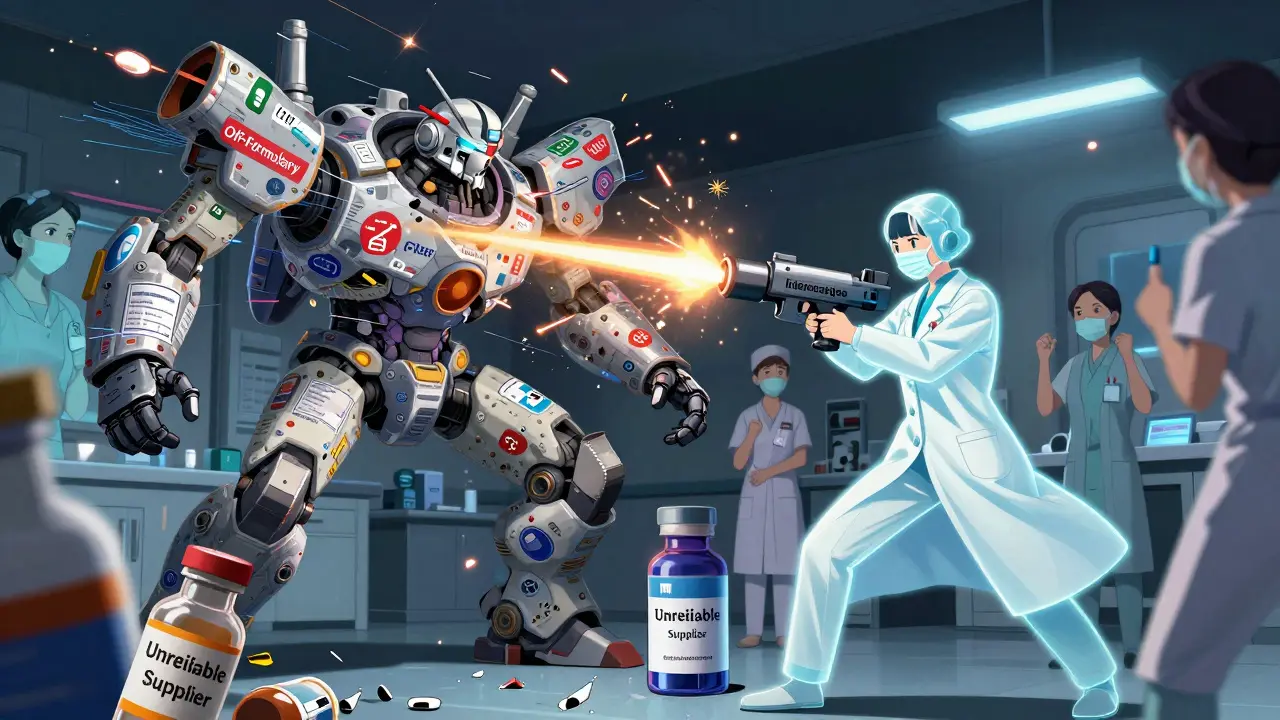
- Supply reliability: A 2022 report tracked 268 generic drug shortages. If a manufacturer has consistent supply issues, the formulary gets pulled - even if the drug is effective. Pharmacists at Massachusetts General Hospital reported suspending formulary status for seven different generics in 2022 due to supply instability.
Tiers and Cost-Sharing
Hospital formularies are usually divided into three to five tiers. Tier 1 is reserved for the most cost-effective, evidence-backed generics. These are the drugs patients get first - with no or minimal out-of-pocket cost. Tier 2 might include slightly more expensive generics or those with less robust data. Tier 3 and above? Brand-name drugs or newer generics with unclear value.
Unlike Medicare Part D, which uses cost-sharing to steer patients toward cheaper drugs, hospitals use therapeutic interchange. That means a pharmacist can automatically swap a non-formulary generic for a preferred one at the pharmacy counter - without asking the doctor. This is legal, safe, and common. But it’s also where friction happens.
Where the System Gets Stuck
For all its logic, the formulary system has real-world friction.
Physicians often complain about prior authorization. A 2021 AMA survey found 32% of doctors said formulary restrictions delayed care. One cardiologist in Chicago told of a patient who needed a specific generic statin - not because it was better, but because it was the only one that didn’t interact with her supplements. The formulary didn’t include it. Approval took two weeks. The patient’s cholesterol spiked.
Nurses report workflow chaos. When a formulary changes, staff must relearn how to administer the new drug. A 2023 survey on AllNurses.com found 73% of nurses saw temporary medication errors during transitions. One nurse described a switch from one generic insulin to another - same name, different pen design. Patients got the wrong dose. It took weeks to train everyone.
And then there’s the influence of pharmaceutical reps. Dr. Jerry Avorn of Harvard documented how sales pitches, even with conflict-of-interest disclosures, still sway decisions. One hospital added a generic because a rep offered free educational materials - not because it outperformed others.

Emerging Trends
The future of formularies is getting smarter.
- Total cost of care: More hospitals (61%, per a 2023 KLAS report) now use predictive analytics to model how a drug affects downstream costs - ER visits, readmissions, dialysis, etc. A cheap generic that causes 30% more readmissions isn’t a bargain.
- Pharmacogenomics: Eighteen percent of academic hospitals are now testing patients’ DNA to guide formulary choices. If someone’s genes make them metabolize a drug too slowly, they might get a different generic - even if it’s slightly more expensive.
- Biosimilars: While traditional generics are straightforward, biosimilars (generic biologics) are complex. Only 37% of hospitals have formal protocols to evaluate them. That’s changing fast as more biosimilars hit the market.
- Value-based contracts: Forty-three percent of hospitals now negotiate deals where manufacturers pay back money if the drug doesn’t reduce hospitalizations. It’s like insurance for outcomes.
Why This Matters
Generic drugs make up 90% of prescriptions in hospitals but only 26% of spending. That’s the power of a smart formulary. Without it, hospitals would be paying billions more each year - and patients would be getting less consistent care.
The system isn’t perfect. It’s slow. It’s bureaucratic. It sometimes blocks access to drugs that could help. But it’s also the reason you don’t end up on a drug that causes liver damage, or a generic that runs out every other month.
At its core, the hospital formulary is about trust. Trust that the decision wasn’t made by a sales rep. Trust that the drug works. Trust that it won’t break. And trust that the hospital is doing the right thing - not just the cheapest thing.
Why do hospitals use closed formularies instead of open ones?
Closed formularies limit drug options to those that have been rigorously reviewed for safety, efficacy, and cost. This reduces variability in care, prevents overprescribing, and lowers overall drug spending. Open formularies, where almost any drug can be ordered, lead to higher costs and inconsistent outcomes. Studies show hospitals with closed formularies achieve 18-22% lower medication costs without harming patient outcomes.
Can a pharmacist substitute a generic drug without asking the doctor?
Yes, in most U.S. hospitals, pharmacists can perform therapeutic interchange - automatically swapping a non-formulary generic for a preferred one - as long as the drugs are therapeutically equivalent and approved by the formulary committee. This is standard practice and legal under state pharmacy laws. However, some states or institutions require physician notification or consent for certain drug classes, like anticoagulants or psychiatric medications.
Do formularies ever exclude effective generic drugs?
Yes. A generic might be clinically effective but excluded if it has poor supply reliability, inconsistent bioavailability, or if a cheaper, equally effective alternative already exists. For example, if three generics for metformin are available, and one manufacturer has frequent shortages, that drug may be removed from the formulary even if it works well. The goal is reliability, not just effectiveness.
How often are hospital formularies updated?
Most academic medical centers review their formularies quarterly. Community hospitals typically update twice a year. Urgent changes - like drug shortages or safety alerts - can trigger emergency reviews within days. The American Society of Health-System Pharmacists (ASHP) recommends formal reviews every 3 to 6 months, with continuous monitoring of new data.
Are there differences between hospital formularies and Medicare Part D formularies?
Yes. Hospital formularies focus on clinical outcomes and total cost of care, with pharmacists able to make automatic substitutions. Medicare Part D focuses on patient cost-sharing, using tiered copays to steer patients toward cheaper drugs. Hospitals don’t care if a patient pays $5 or $20 - they care if the drug reduces readmissions. Medicare cares more about what the patient pays out-of-pocket than how it affects hospital stays.
What Comes Next?
The push for value-based care is accelerating. By 2028, CMS may require all Medicare-certified hospitals to have a formal formulary system. That means even small hospitals will need structured committees, data tracking, and transparent decision-making.
For now, the system works because it’s grounded in evidence - not profit. It’s slow, but it’s deliberate. And when it works right, it saves lives, not just money.
Nicole Blain
March 17, 2026 AT 12:03Prathamesh Ghodke
March 18, 2026 AT 04:40Sanjana Rajan
March 19, 2026 AT 17:05Kyle Young
March 19, 2026 AT 20:38Aileen Nasywa Shabira
March 21, 2026 AT 19:18Kendrick Heyward
March 23, 2026 AT 02:32Lauren Volpi
March 24, 2026 AT 00:08Melissa Stansbury
March 25, 2026 AT 13:25Manish Singh
March 27, 2026 AT 12:04