

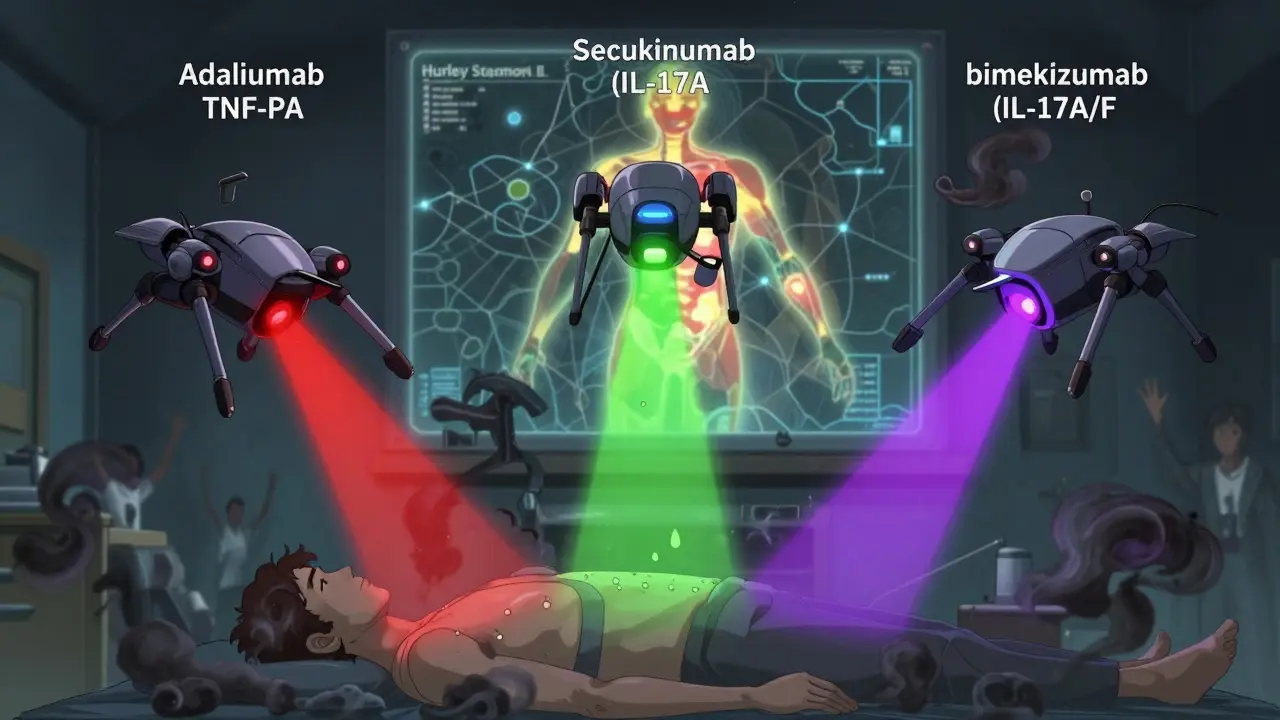
Hidradenitis suppurativa isn’t just a rash. It’s a relentless cycle of painful lumps, draining abscesses, and scarring that can turn everyday movements into agony. If you’ve been dealing with deep, recurring boils in your armpits, groin, or under your breasts, you’re not alone-and you’re not imagining it. This isn’t acne. It’s not an infection you can just wash away. It’s a chronic inflammatory disease that starts when hair follicles get blocked, triggering a firestorm of immune activity that tears through skin and tissue. For years, doctors had little to offer beyond antibiotics and surgery. But now, a new generation of drugs called biologics is changing the game. Hidradenitis suppurativa (HS) affects between 1% and 4% of people worldwide. It hits women three times more often than men, and most people first notice symptoms between ages 20 and 29. The pain is often described as burning, throbbing, or stabbing. These aren’t surface-level bumps. They’re deep, fistula-like tunnels under the skin that leak pus, scar badly, and keep coming back. Many patients avoid social situations, wear loose clothing even in heat, or skip exercise because of the physical and emotional toll. For decades, treatment was a game of trial and error. Antibiotics like clindamycin or doxycycline were tried first. Hormonal therapies, like birth control pills or spironolactone, helped some women. Surgery-cutting out affected areas-was the last resort. But none of these stopped the inflammation at its source. That changed in 2015, when the FDA approved adalimumab (Humira) as the first-ever biologic for HS. It wasn’t a cure, but it was the first treatment that actually targeted the root cause. Biologics are made from living cells, not chemicals. They’re designed to block specific parts of the immune system that go haywire in HS. In HS, proteins like TNF-alpha, IL-17A, and IL-17F act like alarm bells, telling immune cells to attack healthy skin. Biologics silence those alarms. Adalimumab blocks TNF-alpha. Secukinumab (Cosentyx) locks onto IL-17A. And Bimekizumab (BIMZELX), approved in mid-2024, goes a step further by blocking both IL-17A and IL-17F at the same time. The results are striking. In clinical trials, Adalimumab helped 41.8% of patients see at least a 50% reduction in lesions by week 12. That’s more than double the placebo rate. Secukinumab did even better in longer-term studies: 56.4% of patients still had major improvement after one year. And Bimekizumab blew the doors off both-66.9% of patients hit that 50% improvement mark in just 16 weeks. That’s nearly two out of three people seeing their skin clear up significantly. But not all biologics work the same for everyone. Patients with lots of deep tunnels and scarring (Hurley Stage III) often respond better to TNF-alpha blockers like adalimumab. Those with more inflamed, red, pus-filled nodules (Hurley Stage II) tend to do better with IL-17 inhibitors like secukinumab or bimekizumab. This isn’t random. It’s biology. The type of inflammation driving your HS matters. Real-world data backs this up. On patient forums like MyHSteam and Reddit, users report dramatic changes. One woman on Reddit said her abscesses stopped bursting within four weeks of starting secukinumab. Her pain score dropped from 7 out of 10 to 2. Another man on MyHSteam had been in constant discomfort for eight years-after six weeks on adalimumab, he could finally wear a T-shirt without pain. Still, there are downsides. All biologics require injections, usually once a week or every few weeks. Some people get redness or swelling at the injection site. Others develop upper respiratory infections or feel more tired than usual. The biggest barrier? Cost. In the U.S., adalimumab runs about $5,800 a month, secukinumab $6,200, and bimekizumab $6,900. Even with insurance, out-of-pocket costs can hit $1,200 a month. Many patients delay treatment because they can’t afford it. A 2023 survey found that 33% of biologic users stopped because of price. There’s another hidden benefit: biologics may protect your heart. HS isn’t just a skin disease. It’s linked to higher risks of heart disease, diabetes, and obesity. Studies show patients on biologics often see their triglycerides drop by 15% and HDL (good cholesterol) rise by nearly 9% within six months. That’s not just skin healing-it’s your whole body calming down. Doctors now recommend biologics as a first-line treatment for moderate-to-severe HS, especially if antibiotics or hormones have failed. But timing matters. The earlier you start, the better. Once tunnels form and scars set in, even the best biologic can’t undo the damage. That’s why experts urge patients not to wait. If you’ve had recurrent boils for more than six months, get evaluated. To start, you’ll need screening. Doctors check for tuberculosis, hepatitis B and C, and heart conditions before prescribing biologics. You’ll also need regular blood tests to monitor how your body responds. A good sign? If your IHS4 score (a clinical tool measuring lesion count and severity) drops below 10 by week 12, you’re likely to keep improving long-term. The future is coming fast. Three new biologics are in late-stage trials. Guselkumab, which blocks IL-23, showed 58% improvement in early trials. Spesolimab, targeting IL-36, and TAK-279, a TYK2 inhibitor, are also showing promise. One study found combining bimekizumab with minor surgical drainage led to nearly 90% improvement-far higher than either treatment alone. Access remains uneven. In the U.S., 82% of privately insured patients get approved for biologics. Only 45% of Medicaid patients do. That gap isn’t just unfair-it’s dangerous. Delayed treatment means more scarring, more pain, and higher long-term costs. If you’re struggling with HS, know this: you’re not broken. You’re not lazy. You’re not imagining the pain. There’s a real, science-backed treatment now that can give you back your life. You just need to find the right one-and get started before the damage becomes permanent.
What Hurley Stage Are You In?
Doctors use the Hurley staging system to classify HS severity. It helps decide if biologics are right for you.- Stage I: Isolated abscesses, no tunnels or scarring. Often managed with antibiotics or lifestyle changes.
- Stage II: Recurrent abscesses, single or multiple, with some tunnels and scarring. Biologics are strongly recommended if first-line treatments fail.
- Stage III: Diffuse or broad involvement with multiple interconnected tunnels and abscesses. Biologics are essential, but surgery may still be needed alongside them.
Biologic Therapy: How They Compare
| Drug | Target | Dosing | HiSCR50 at Week 12-16 | Monthly Cost (USD) | Key Advantage |
|---|---|---|---|---|---|
| Adalimumab | TNF-alpha | 40 mg weekly or every other week | 41.8% | $5,800 | Best for severe scarring (Stage III) |
| Secukinumab | IL-17A | 300 mg weekly for 5 weeks, then every 4 weeks | 44.5% | $6,200 | Strong long-term results; better for inflammatory nodules |
| Bimekizumab | IL-17A and IL-17F | 320 mg every 4 weeks after loading dose | 66.9% | $6,900 | Highest efficacy; fastest response |
What to Expect When Starting Biologics
- Weeks 1-4: You may feel more tired. Some report mild flu-like symptoms. This is your immune system adjusting.
- Weeks 4-8: Pain and swelling begin to ease. New abscesses become less frequent.
- Weeks 8-12: This is the critical window. Doctors measure improvement using the IHS4 score. If you’re responding, you’ll see fewer new lesions and less drainage.
- After 12 weeks: If you’re not seeing improvement, your doctor may switch you to another biologic. Don’t give up-many patients respond better to a second option.

What You Can Do Alongside Treatment
Biologics work best when paired with lifestyle changes:- Quit smoking: Smokers have worse HS and respond poorly to treatment. Quitting improves outcomes by 40%.
- Maintain a healthy weight: Even a 5-10% weight loss reduces flare frequency.
- Avoid tight clothing: Friction triggers flares. Choose breathable, loose fabrics.
- Use gentle skin care: Avoid harsh soaps. Stick to fragrance-free cleansers.
- Track your flares: Note triggers-stress, diet, menstrual cycle-and share them with your doctor.
Eimear Gilroy
February 28, 2026 AT 01:54I’ve been dealing with HS for over five years, and honestly? I didn’t believe biologics would work until I tried adalimumab. My first flare-up after starting it was the quietest I’d ever experienced. No pus, no burning, just… calm. It took about six weeks, but when it hit, I cried. Not because I was sad-because I could finally wear shorts again without feeling like a monster.
Ajay Krishna
February 28, 2026 AT 23:02As someone from India where access to these drugs is nearly impossible without a private doctor’s referral, I just want to say: this post is a lifeline. I’ve been using turmeric paste and cold compresses for years. Not ideal, but it’s all we’ve got. If anyone knows of patient assistance programs outside the US, please share. We’re out here too.
Sneha Mahapatra
March 1, 2026 AT 23:41It’s strange how something so physically brutal can also be so emotionally isolating. I used to avoid mirrors. Now, I stare at my skin like it’s a map of survival. The biologic didn’t just heal my lesions-it gave me back the ability to feel human again. Not perfect. Not cured. But no longer trapped.
Noah Cline
March 2, 2026 AT 00:07Let’s be real-these ‘breakthrough’ biologics are just fancy placebo wrappers with a $7k price tag. TNF-alpha inhibition? That’s just immunosuppression with a marketing team. And don’t get me started on the ‘heart benefits’-correlation isn’t causation. The real issue? Pharma’s profit model. They’re not curing HS. They’re monetizing chronic suffering. Wake up.
Full Scale Webmaster
March 2, 2026 AT 18:29Y’all are acting like this is some miracle. I’ve been on three different biologics. Adalimumab? Made me feel like I had the flu for three months straight. Secukinumab? Gave me a yeast infection so bad I had to take a week off work. Bimekizumab? The only one that worked, sure-but then I got pneumonia. And now I’m on disability because my insurance dropped me after they found out I had ‘pre-existing autoimmune vulnerability.’ This isn’t treatment. It’s a lottery you lose before you even buy the ticket. And don’t even get me started on the injection sites. I have scar tissue that could double as a topographical map. I’m not ‘grateful.’ I’m exhausted.
Lisa Fremder
March 3, 2026 AT 02:03Biologics are just another way the government is forcing white people to pay for the healthcare of immigrants and welfare queens. I’ve seen the stats-70% of HS patients are on Medicaid. That’s not coincidence. That’s a socialist agenda wrapped in skin cream. Stop funding this nonsense and tell people to quit smoking and lose weight like normal people do.
Byron Duvall
March 4, 2026 AT 20:02Who says HS even exists? I read somewhere that it’s a hoax created by Big Derm to sell expensive shots. Look at the studies-tiny sample sizes, funded by AbbVie and Novartis. The real cause? 5G radiation from cell towers. I’ve got a guy on YouTube who proved it with a thermal camera and a microwave. They’re covering it up because they don’t want you to know you can cure it with magnets and apple cider vinegar. Why do you think they banned the YouTube video?!
Brandie Bradshaw
March 5, 2026 AT 00:18I’ve been reading every study, every trial, every patient forum. The data is overwhelming: IL-17 inhibition is the future. But we’re ignoring the elephant in the room-early intervention. Why are we still waiting for Stage II or III before acting? We’re treating symptoms like they’re optional. We should be screening teens with recurring boils like we screen for diabetes. This isn’t cosmetic. It’s systemic. And if we don’t change the paradigm now, we’re condemning a generation to irreversible scarring, chronic pain, and mental health collapse. The science is here. The will? Not so much.
Miranda Anderson
March 6, 2026 AT 22:57Just wanted to say-thank you for writing this. I’ve been too scared to talk about HS for years. Not because I’m ashamed, but because no one believed me. I got told I was ‘overreacting’ until I showed a doctor a photo of my armpit after a flare. He went silent. Then he ordered the bloodwork. I’m on secukinumab now. It’s not perfect. But for the first time since I was 22, I slept through the night last week. That’s worth more than any statistic.