

When you pick up a prescription, you might not think about why one pill costs $5 and another costs $50-even if they do the exact same thing. The truth is, the price difference isn’t about effectiveness. It’s about timing, competition, and how we measure value in healthcare. Cost-effectiveness analysis is the tool that cuts through the noise and shows us which drugs actually deliver the most health for the least money. And when it comes to generics, this analysis isn’t just useful-it’s essential.
What Exactly Is Cost-Effectiveness Analysis?
Cost-effectiveness analysis, or CEA, is a way to compare how much a treatment costs versus how much health it gives you. It doesn’t just look at the price tag. It looks at outcomes: how many extra days, months, or years of healthy life a drug gives patients. The most common unit of measurement is the quality-adjusted life year, or QALY. One QALY equals one year of perfect health. If a drug extends life by two years but the patient spends half that time sick, that’s 1.5 QALYs. For brand-name drugs, this calculation is straightforward: you take the price, divide it by the health benefit, and get an incremental cost-effectiveness ratio (ICER). But with generics, things get messy. Why? Because their prices don’t stay the same. They drop-sometimes dramatically-when competitors enter the market. A CEA that ignores this reality is like trying to predict the weather using last year’s forecast.How Much Do Generics Actually Save?
The numbers speak for themselves. When the first generic version of a brand-name drug hits the market, prices typically fall by 39%. When six or more generic manufacturers start selling the same drug, prices plunge more than 95% below the original brand price. That’s not a small discount. That’s a revolution. Over the last decade, generic drugs saved the U.S. healthcare system $1.7 trillion. In 2022, generics made up 90% of all prescriptions filled-but only 17% of total drug spending. That’s the power of competition. A drug that cost $200 a month as a brand can drop to $4 a month as a generic. For patients on chronic medications like statins, blood pressure pills, or diabetes drugs, that’s life-changing. But here’s the twist: not all generics are created equal. A 2022 study in JAMA Network Open looked at the top 1,000 most-prescribed generics and found 45 of them were priced 15.6 times higher than other drugs in the same therapeutic class-even though they worked the same way. One drug, for example, cost $1,200 a month as a generic, while another generic for the same condition cost just $77. Both were FDA-approved. Both were equally effective. The only difference? Price.Why Do Some Generics Cost So Much?
You’d think that once a patent expires, competition would drive prices down across the board. But that’s not always what happens. Sometimes, a single manufacturer holds a monopoly on a specific formulation-say, a once-daily extended-release version-and charges a premium. Other times, a generic version has a different dosage form-like a tablet versus a capsule-and gets priced higher even though it’s clinically identical. The JAMA study found that when generics were substituted with a different drug in the same class (therapeutic substitution), prices were 20.6 times higher than the cheapest alternative. Even when it was the same drug but a different brand, prices were still 20.2 times higher. The smallest price gap? Between two identical pills made by different companies. On average, one cost just 1.4 times more than the other. So why do insurers and pharmacy benefit managers (PBMs) keep the expensive ones on their formularies? Because of spread pricing. PBMs negotiate a price with pharmacies, then pay the pharmacy less. The difference-the “spread”-goes straight into the PBM’s pocket. If a $1,200 generic gets dispensed and the PBM collects a $500 spread, they have a financial incentive to keep it on the list-even if a $77 alternative exists.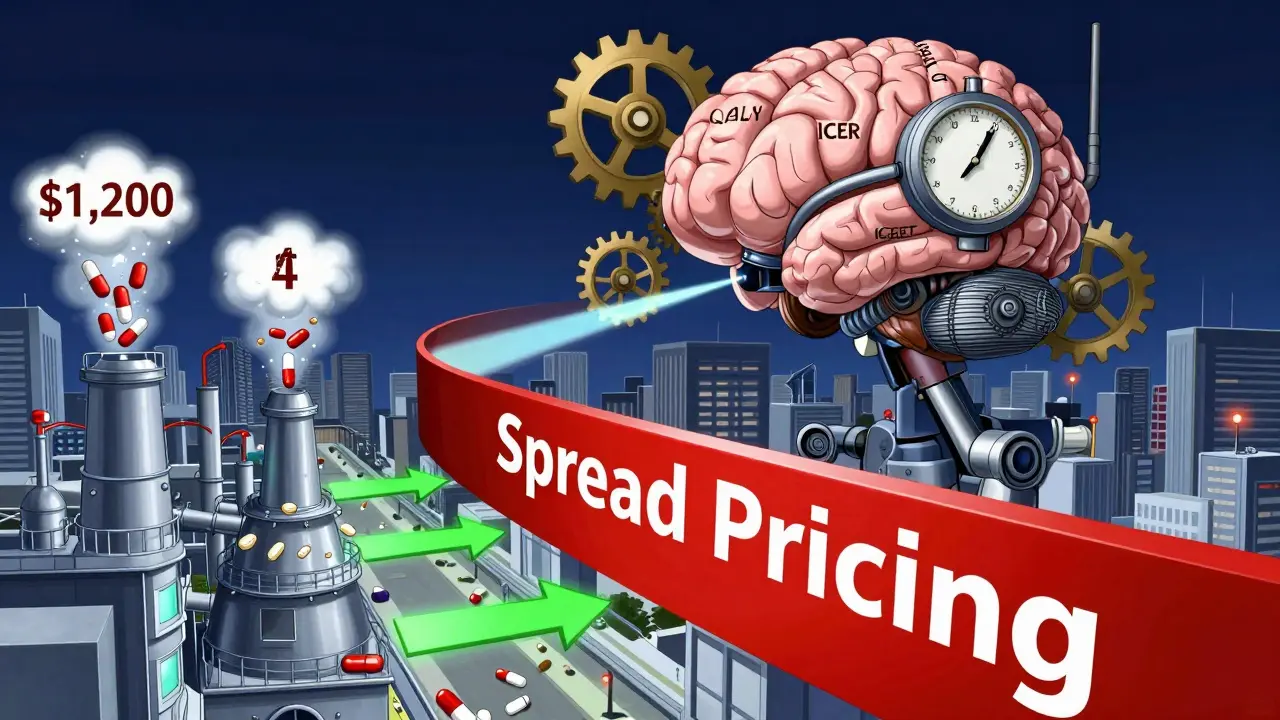
How CEA Gets It Wrong (And How to Fix It)
Here’s the biggest problem: 94% of published cost-effectiveness analyses don’t account for what happens after a patent expires. They use today’s price as if it’s forever. That’s like judging a car’s value based on its sticker price on day one, ignoring depreciation. A CEA that ignores future generic entry will wrongly make brand-name drugs look more cost-effective than they are. It will make new, expensive drugs look like a better investment than they really are. That’s not just inaccurate-it’s dangerous. It can lead to coverage decisions that cost patients and payers billions. Experts like Dr. John Garrison argue that traditional CEA creates “pricing anomalies” that distort innovation. If companies know their drug will be analyzed without factoring in future generic competition, they have no reason to lower prices early. They wait until the last possible moment, maximizing profits while the system pays the price. The fix? Analysts need to model generic entry like a timeline. When will the patent expire? How many manufacturers are likely to enter? What’s the historical price drop for similar drugs? The NIH now recommends that CEA models include expected price reductions following patent cliffs. Some agencies, like ICER, are already doing this. Most aren’t.Therapeutic Substitution: The Hidden Savings Opportunity
One of the most powerful tools in cost-effectiveness analysis isn’t switching to a cheaper generic-it’s switching to a different drug altogether. Sometimes, a completely different medication, not even a generic of the original, can do the same job for a fraction of the cost. For example, instead of using a $1,200 generic statin, a doctor might switch a patient to a $40 generic from a different drug class that works just as well. The JAMA study showed this kind of substitution could cut spending by 88% in some cases. And it’s not rare. Among the top 1,000 generics, nearly 5% had cheaper, equally effective alternatives in the same therapeutic class. This isn’t about cutting corners. It’s about smart prescribing. Clinical guidelines already support therapeutic substitution when evidence shows equivalent outcomes. The barrier isn’t medical-it’s financial. PBMs, formulary design, and outdated CEA models all work against it.
What’s Changing Now?
The landscape is shifting. The 2022 Inflation Reduction Act gives Medicare new power to negotiate drug prices. The 2020 Drug Pricing Reduction Act pushes Medicare Part D to favor lower-cost options. More payers are starting to require cost-effectiveness data before covering new drugs. And with over 300 small-molecule drugs losing patent protection between 2020 and 2025, the pressure to get CEA right is only growing. Health technology assessment agencies in Europe have been using formal CEA for years-over 90% of them. In the U.S., only 35% of commercial payers do. But that’s changing. As drug costs keep rising and budgets tighten, the ones who ignore cost-effectiveness will be the ones left behind.What Patients and Providers Can Do
You don’t need to be an economist to use cost-effectiveness principles. If you’re on a long-term medication, ask your doctor: “Is there a cheaper generic-or even a different drug-that works just as well?” Don’t assume your prescription is the only option. Pharmacists can often suggest alternatives that aren’t on the formulary but are just as effective. For providers, it’s about asking the right questions before writing a script. Is this the lowest-cost option in its class? Is there a therapeutic alternative? Has the patent expired? Are we paying for a brand-name price on a generic? And for everyone: demand transparency. Ask your insurer why they cover a $1,000 generic when a $50 one exists. Push for formularies that prioritize value, not profit.Final Thoughts: Value Isn’t Just About Price
Cost-effectiveness analysis isn’t about cheapening care. It’s about making sure every dollar spent on medicine delivers the most health possible. Generics aren’t a compromise-they’re a triumph of competition and science. But only when we measure them right. The real cost isn’t the price on the bottle. It’s the missed opportunity when we pay more than we have to. When we ignore the data, we don’t just waste money-we waste health. And that’s something no price tag can fix.Are generic drugs as effective as brand-name drugs?
Yes. The FDA requires generic drugs to have the same active ingredient, strength, dosage form, and route of administration as the brand-name version. They must also meet the same strict standards for quality, purity, and performance. Studies consistently show that generics work just as well. The only differences are in inactive ingredients like fillers or dyes, which don’t affect how the drug works in your body.
Why do some generic drugs cost more than others?
Price differences between generics come from manufacturing, formulation, and market dynamics-not effectiveness. A once-daily extended-release version might cost more than a twice-daily immediate-release version, even if they’re the same drug. Sometimes, a single manufacturer holds a monopoly on a specific form, allowing them to charge more. Other times, Pharmacy Benefit Managers (PBMs) profit from higher prices through spread pricing, keeping expensive generics on formularies even when cheaper alternatives exist.
How does cost-effectiveness analysis help patients save money?
CEA identifies which treatments offer the best health outcomes for the lowest cost. By comparing drugs within the same class-not just generics versus brands-it reveals cheaper alternatives that work just as well. For example, switching from a $1,200 generic to a $77 alternative in the same therapeutic class can save thousands per year. When payers use CEA to guide coverage decisions, patients get access to lower-cost options without sacrificing care.
Why don’t all insurers use cost-effectiveness analysis?
Many U.S. commercial insurers don’t use formal CEA because they rely on proprietary formulary systems and contracts with drug manufacturers and PBMs. These systems often prioritize rebates and spreads over true cost-effectiveness. Additionally, CEA requires expertise, data, and time-resources many insurers lack. In contrast, European health agencies and Medicare Part D are increasingly adopting CEA because they’re under pressure to control spending and improve value.
Can I ask my doctor to switch me to a cheaper generic?
Absolutely. You have the right to ask if there’s a lower-cost generic or therapeutic alternative that works just as well. Doctors are encouraged to consider cost when prescribing, especially for chronic conditions. Bring up the topic during your appointment, and don’t be afraid to ask for a cost comparison. Many pharmacies can print out price options for different medications, helping you and your doctor make an informed decision.
What’s the biggest mistake in cost-effectiveness analysis for generics?
The biggest mistake is using today’s price as if it will stay the same forever. Most published analyses ignore the fact that generic prices drop dramatically after patent expiration and as more manufacturers enter the market. A CEA that doesn’t account for future price declines will wrongly favor expensive brand-name drugs and discourage the use of generics-even when they’re the better value. Forward-looking models that predict generic entry and price trends are essential for accurate decisions.
Vatsal Srivastava
February 2, 2026 AT 17:17Generics are just branded placebos with different packaging. If you’re not paying more, you’re not getting real medicine. The FDA? Please. They’re just rubber-stamping whatever Big Pharma lets them.
Brittany Marioni
February 2, 2026 AT 18:15Wow-this is such an important, nuanced conversation! I just want to say, thank you for sharing this! It’s so easy to assume that ‘generic’ means ‘inferior,’ but the data shows the opposite! And the fact that PBMs profit from spread pricing? That’s just… unethical. We need to push for transparency, and I’m so glad you mentioned asking your doctor! Let’s all be advocates for our health! 💪
Monica Slypig
February 4, 2026 AT 02:29USA invented modern medicine and now we’re letting cheap imports ruin everything? No wonder our system’s broken. If you want quality care you pay for it. Period. These generics are made in labs where they don’t even wash their hands before packaging. I’d rather pay $200 than risk my life with some Indian factory’s dust.
Becky M.
February 4, 2026 AT 13:00i just wanted to say… this really opened my eyes. i’ve been on a generic blood pressure med for years and never thought to ask if there was something cheaper. i had no idea pbms were making money off the spread. that’s wild. and honestly? it feels kinda gross. maybe next time i’m at the pharmacy, i’ll ask the pharmacist what else is out there. thanks for writing this.
jay patel
February 5, 2026 AT 22:42you know what’s funny? people act like generics are some kind of scam, but the truth is, the real scam is the system that lets one company charge $1,200 for a pill that’s chemically identical to one that costs $77. and then they wonder why people can’t afford meds. it’s not about the drug-it’s about the middlemen who get rich while you skip meals. i’ve seen friends choose between insulin and rent. this isn’t healthcare-it’s a rigged casino. and we’re all just betting our lives on it.
phara don
February 6, 2026 AT 04:08so if generics are so cheap and effective, why do some still cost a fortune? is it just lack of competition? or is it something else? like… do companies buy up patents just to sit on them? 🤔
Hannah Gliane
February 7, 2026 AT 09:10Oh wow, someone actually wrote a 2,000-word essay on pill prices? 🙄 And you’re shocked that people pay more? Honey, this is America. If you don’t want to be fleeced, don’t be dumb. Stop asking for ‘cheap’ and start asking for ‘insurance that doesn’t suck.’ Also, your doctor probably doesn’t care about your wallet-they’re paid to write scripts, not play financial advisor. 😘
Murarikar Satishwar
February 7, 2026 AT 21:26This is one of the clearest breakdowns of generic drug economics I’ve ever read. The point about CEA models ignoring future price drops is critical-most studies are like using a 2010 map to navigate 2024. And the therapeutic substitution stats? Eye-opening. If we’re serious about value-based care, we need to stop treating ‘generic’ as a dirty word and start treating ‘price transparency’ as a right. Kudos to the author for calling out PBMs too. This should be required reading for every med student.
Bob Hynes
February 9, 2026 AT 13:38Man, I just moved from Canada where we pay $5 for everything, and this whole thing feels like a dystopian soap opera. I got my statin for $3 CAD last month. Here? $40 for the same thing. And they call this innovation? I don’t get how we let this happen. We’re not a third-world country-we’re the richest nation on earth. Why are we punishing people for being sick?
clarissa sulio
February 10, 2026 AT 07:45Everyone’s talking about generics like they’re the solution, but let’s be real-most people don’t even know what’s in their meds. The system’s broken, but the answer isn’t just switching pills. It’s fixing the entire supply chain. And until Congress stops taking pharma money, nothing changes. End of story.
Bridget Molokomme
February 11, 2026 AT 05:45So you’re saying the real villain isn’t Big Pharma… it’s the middlemen? Funny. I always thought it was the greedy doctors. 😏